
Asian Games 2026 Mascot Logo: The Story Behind Honohon and the Emblem
- Written by: UKSports
- Published on:
- Read Time: 6 min
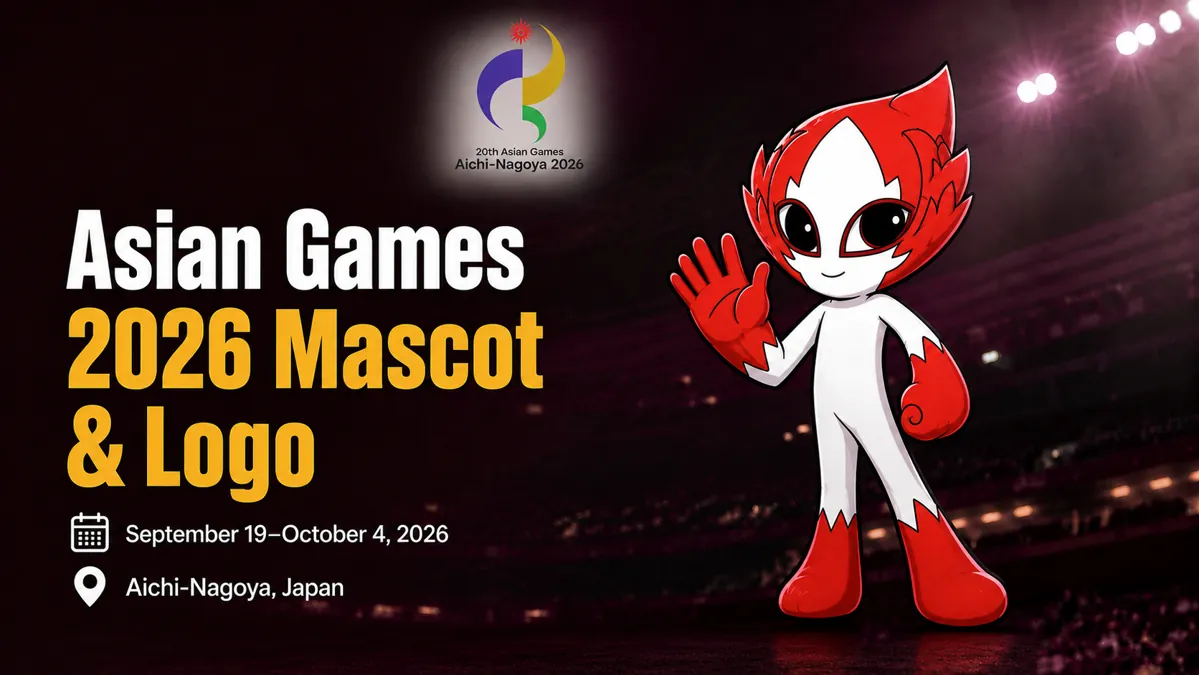
The Asian Games 2026 mascot logo actually covers two separate pieces: Honohon, the event’s mascot character, and the Aichi-Nagoya 2026 emblem. Together they give the Games both a personality people can connect with and a design rooted in the host region’s culture.
Anyone who’s come across the character or the colorful emblem online might have questions what kind of creature is Honohon, why the mix of purple, gold, and green, and where the official artwork actually lives. This guide walks through all of that in straightforward terms.
Quick Facts
Honohon serves as the Games’ official mascot, built around a story that fuses the competitive fire inside athletes with the Shachihoko, a protective figure tied to the Aichi-Nagoya region. The emblem itself relies on sweeping curved lines and a red sun to communicate athleticism, togetherness, and forward motion. Official mascot profile; official emblem explanation.
| Question | Answer |
|---|---|
| Official event name | 20th Asian Games Aichi-Nagoya 2026 |
| Host country | Japan |
| Mascot name | Honohon |
| Official slogan | IMAGINE ONE ASIA |
| Dates | September 19 – October 4, 2026 |
The formal opening ceremony is set for September 19, though certain competitions kick off before that date worth double-checking individual sport schedules if you’re planning to tune in.
Getting to Know Honohon
Honohon was designed to embody the Aichi-Nagoya Games. According to the official backstory, the character grows out of the intense emotion athletes carry with them, which turns into flame and merges with the Shachihoko pairing the spirit of competition with a symbol tied directly to the host area.
The name traces back to “Honoho,” an older word tied to fire, softened into something more approachable for a mascot.
A few defining traits:
- Big eyes – meant to take in athletes competing all across Asia
- Ears shaped like the Shachihoko – tuned to crowd noise and kids’ laughter
- A curious streak – always eager to explore and learn
- A genuine enthusiasm for sport– driven to understand every event in the Games
There’s even a lighthearted flaw built into the character profile: Honohon tends to get sleepy after working too hard. Small details like that make the mascot stick in people’s minds more than a name and image alone would.
So Is Honohon an Animal, or Something Else?
Honohon isn’t really an animal in the conventional sense it’s a made-up figure drawing from both flame imagery and the Shachihoko. Labeling it simply as “a tiger” or “a fish” leaves out most of the story.
The Olympic Council of Asia describes the Shachihoko as a legendary tiger-fish hybrid pulled from Japanese folklore. Honohon builds on that tradition while also standing in for the determination athletes bring to competition.
This distinction is worth knowing if you’re digging into the mascot’s meaning the character isn’t a generic sports cartoon. It’s deliberately tied to the place hosting the event, which gives different people different points of connection: kids might respond to the expression on its face, sports fans to the fire theme, and anyone curious about Japan to the Shachihoko link.
Decoding the Asian Games 2026 Emblem
The official emblem sometimes just called the Games logo uses flowing, curved shapes to capture athletic energy. Those lines converge toward a bright red sun, the established symbol of the Olympic Council of Asia, expressing the idea of people coming together and pushing toward what’s ahead.
What the Colors Stand For
- Purple – nods to the iris, the flower associated with Aichi prefecture
- Gold – references the Kinshachi, golden tiger-fish ornaments found on Nagoya Castle
- Green – points to the region’s focus on environmental care
- Red – the OCA’s sun symbol
Hidden Letterforms
Look closely and there’s more going on: the purple curve combined with the central line is shaped to suggest an “A,” tying together Asia and Aichi, while the purple and gold shapes together form an “N” for Nagoya. Designer Hiroshi Miyashita is credited as the creator behind the emblem.
Next time the emblem crosses your feed, try spotting those letters before your eye lands on the event name below it details that are easy to miss in a small thumbnail.
Mascot or Logo – What’s the Actual Difference?
These two elements do related but distinct jobs. A mascot is a character it has a name, a personality, a story. An emblem or logo is purely a visual identifier for the event.
That’s also why searching “Asian Games 2026 mascot logo” turns up such a mixed bag of images sometimes the character, sometimes the emblem, sometimes promotional graphics combining both.
To narrow your search:
| Looking for… | Try searching |
|---|---|
| The character itself | Aichi-Nagoya 2026 Honohon mascot |
| The event symbol | Aichi-Nagoya 2026 official emblem |
| The event’s tagline | Aichi-Nagoya 2026 official slogan |
| An explainer on the designs | Asian Games 2026 mascot logo meaning |
Being specific with your search terms saves time, especially if you need the right image for a presentation or write-up.
The Meaning Behind “IMAGINE ONE ASIA”
The slogan is an invitation to picture a more unified Asia through the lens of sport. Organizers frame it around sport’s capacity to bridge gaps in language, culture, and nationality extending to athletes, volunteers, and spectators alike who share in the experience of the Games.
It’s a concept that plays out simply in any given match: you don’t need to share a language with an athlete to appreciate a strong finish, a tense race, or good sportsmanship. The slogan puts language to that shared moment, while the mascot and emblem give it visual shape.
Finding Official Mascot and Emblem Artwork
The organizing committee’s own website is the best starting point for genuine images specifically the official mascot page introducing Honohon, and the page covering the emblem, slogan, and core Games graphics.
A Quick Way to Verify an Image
- Open the original source page – a thumbnail by itself doesn’t tell you much.
- Confirm the event name and year match Aichi-Nagoya 2026.
- Compare the design carefully for altered text, missing pieces, or off colors.
- Read the caption to make sure the image is properly identified.
- Note any usage terms listed – just seeing an official image doesn’t mean you know how it can be reused.
For schoolwork, hang on to the source link with your notes. For any published writing, keep the credit attached to the caption. Both habits make it much easier to double-check things later.
Honohon Out in the World
Honohon has already been making appearances beyond Japan to build buzz for the Games. In July 2026, the Olympic Council of Malaysia hosted the mascot in Kuala Lumpur ahead of an Asian Games Fun Run, where its presence helped promote the event and tie into finisher medals for participants.
It’s a good example of what a mascot is actually for introducing the Games to people who might not yet be following the competition calendar or know the athletes involved. It also gives smaller, local events a fun run, a school activity, a photo opportunity a tangible link to the larger occasion, sometimes becoming someone’s very first exposure to Aichi-Nagoya 2026.
Getting Ready to Watch
Once the official designs make sense, the next step is lining up which sports and sessions to actually watch. A simple checklist helps:
- Pick out your favorite sports to follow
- Note dates for both preliminary rounds and finals
- Double-check your time zone before setting any reminders
- Revisit viewing details close to the event, since things can shift
- Rely on the organizers’ official schedule for last-minute changes
For a full breakdown of the TV channel, streaming app, and India time-zone details, check out our complete Where to Watch Asian Games 2026 guide.
Frequently Asked Questions
What’s the mascot of the Asian Games 2026 actually called?
Honohon written as HONOHON on the organizing committee’s English-language profile.
Does “Asian Games 2026 mascot logo” describe just one design?
No, it typically covers two distinct things: the Honohon character and the separate Games emblem. Worth specifying which one you’re after when searching.
What does the red sun in the emblem symbolize?
It represents the Olympic Council of Asia, tying into the emblem’s broader theme of unity and moving forward together.
Where exactly are the 2026 Asian Games being held?
Japan is hosting, under the Aichi-Nagoya 2026 name, with the Games running September 19 through October 4, 2026.
How do I know if a mascot image I found online is legitimate?
Cross-check it against the organizing committee’s official mascot page and verify where it was originally published. Holding onto the original source link is more reliable than trusting an image-search preview alone.