

Asian Games History: From Origins to a Continental Tradition
Asian Games history is, in many ways, the story of modern Asia’s rise as a sporting power. Popularly known as the Asiad, the Asian Games is a continental multi-sport event held every four years and organized today by the Olympic Council of Asia (OCA).
What started in 1951 with 11 nations and six sports has grown into one of the world’s biggest multi-sport events, bringing together athletes from across Asia to compete in sports ranging from athletics, swimming, and shooting to kabaddi, wushu, cricket, and esports.
What Are the Asian Games?
The Asian Games are a continental multi-sport competition featuring athletes and teams from across Asia. The event includes both Olympic sports and several sports with strong regional popularity, such as kabaddi, sepak takraw, and wushu.
The Games are held every four years and have become an important pathway for Asian athletes competing at the highest continental level. Over more than seven decades, the event has evolved from a small gathering in New Delhi into a major international sporting festival.
History and Origin of the Asian Games
The roots of the Asian Games can be traced to the Far Eastern Championship Games, an early Asian sporting competition first held in Manila in 1913. It involved countries including Japan, China, and the Philippines and continued until 1934.
Political tensions and the outbreak of World War II brought an end to that competition. The idea of creating a broader Asian sporting event later resurfaced.
At the 1947 Asian Relations Conference in New Delhi, Indian IOC member Guru Dutt Sondhi proposed a continent-wide sporting event that could bring Asian nations together. With support from the Maharaja of Patiala, Yadavindra Singh, the Asian Games Federation (AGF) was established in 1949.
India offered to host the first edition, and New Delhi became the birthplace of the modern Asian Games.
1951 New Delhi: Where It All Began
The first Asian Games were held in New Delhi, India, from 4 to 11 March 1951. The Games took place at New Delhi’s National Stadium, now known as the Major Dhyan Chand National Stadium. Despite limited sporting infrastructure and a relatively short preparation period, the inaugural event attracted 489 athletes from 11 nations.
The participating nations were:
- Afghanistan
- Burma
- Ceylon
- India
- Indonesia
- Iran
- Japan
- Nepal
- Philippines
- Singapore
- Thailand
Athletes competed in six sports:
- Athletics
- Aquatics
- Basketball
- Cycling
- Football
- Weightlifting
Japan topped the medal table with 24 gold, 21 silver and 15 bronze medals, while host India finished second with 51 medals.
Indian swimmer Sachin Nag won India’s first Asian Games gold medal in the 100m freestyle. Roshan Mistry became the first Indian woman to win an Asian Games medal with silver in the 100m sprint, while wrestler K. D. Jadhav also won gold.
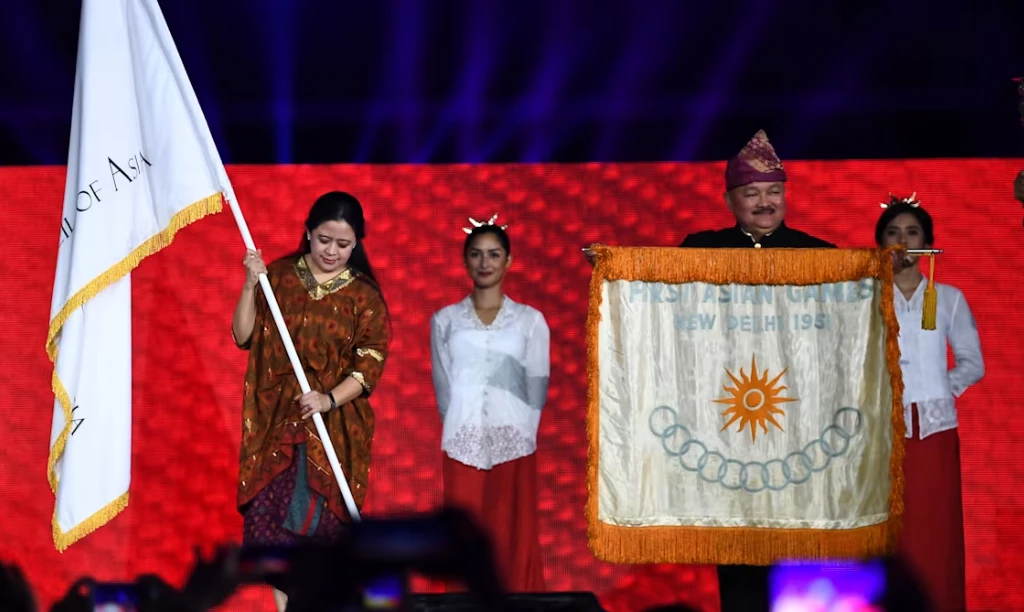
Asian Games Timeline: 1951 to 2026
From its modest beginning in New Delhi, the Asian Games expanded across the continent. Each edition introduced new sports, larger contingents, and new sporting milestones.
| Edition | Year | Host City, Country | Notable Highlight |
|---|---|---|---|
| I | 1951 | New Delhi, India | Inaugural edition; 11 nations, 6 sports |
| II | 1954 | Manila, Philippines | Second edition; first outside India |
| III | 1958 | Tokyo, Japan | Sports programme expanded |
| IV | 1962 | Jakarta, Indonesia | Badminton debuted; political controversy |
| V | 1966 | Bangkok, Thailand | Thailand’s first hosting |
| VI | 1970 | Bangkok, Thailand | Bangkok stepped in after Seoul withdrew |
| VII | 1974 | Tehran, Iran | Israel’s last Asian Games appearance |
| VIII | 1978 | Bangkok, Thailand | Bangkok stepped in after Pakistan withdrew |
| IX | 1982 | New Delhi, India | India’s second hosting; mascot Appu introduced |
| X | 1986 | Seoul, South Korea | First Games under the OCA |
| XI | 1990 | Beijing, China | China’s first hosting |
| XII | 1994 | Hiroshima, Japan | Japan’s second hosting |
| XIII | 1998 | Bangkok, Thailand | Thailand’s fourth hosting |
| XIV | 2002 | Busan, South Korea | Major expansion in participation |
| XV | 2006 | Doha, Qatar | First Games in West Asia |
| XVI | 2010 | Guangzhou, China | China’s second hosting |
| XVII | 2014 | Incheon, South Korea | South Korea’s third hosting |
| XVIII | 2018 | Jakarta-Palembang, Indonesia | Esports introduced as a demonstration sport |
| XIX | 2022/2023 | Hangzhou, China | Postponed to 2023; esports and breaking became medal sports |
| XX | 2026 | Aichi-Nagoya, Japan | Japan’s third hosting |
Steady Expansion Through the Decades
The Asian Games expanded significantly after the inaugural New Delhi edition. Manila hosted the second Games in 1954, followed by Tokyo in 1958 and Jakarta in 1962. Bangkok then hosted the Games multiple times, including 1966, 1970, 1978 and 1998.
The 1974 Games were held in Tehran before New Delhi hosted the event again in 1982. By then, participation had increased dramatically, with 33 nations and more than 3,400 athletes taking part. Seoul, Beijing, Hiroshima, Bangkok and Busan subsequently hosted the Games, with every generation bringing new sports, larger audiences and greater international attention.
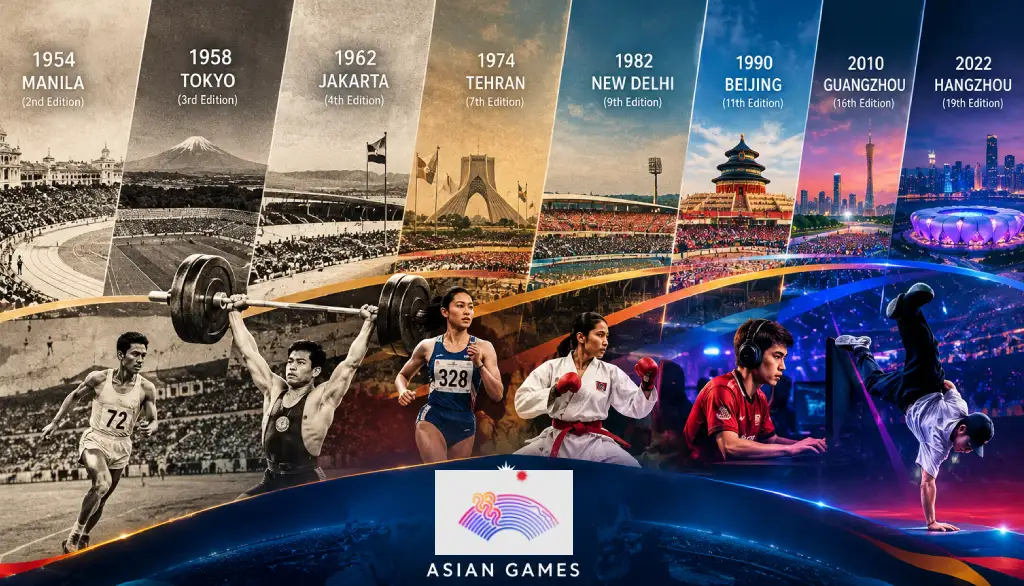
Asian Games Host Countries and Host Cities
The Asian Games have been hosted by countries across different parts of Asia, from South Asia and East Asia to Southeast Asia and West Asia.
The first 20 editions have been hosted by:
- India
- Philippines
- Japan
- Indonesia
- Thailand
- Iran
- South Korea
- China
- Qatar
Thailand has hosted the Asian Games four times, making it the most frequent host. Bangkok hosted the Games in 1966, 1970, 1978 and 1998. Japan, China and South Korea have each hosted the Games three times when the 2026 edition is included for Japan. India has hosted the Asian Games twice, both times in New Delhi – in 1951 and 1982.
Future editions will take the Games to Doha, Qatar, in 2030 and Riyadh, Saudi Arabia, in 2034.
Asian Games Sports: How the Programme Has Changed
The Asian Games sports programme has changed considerably since 1951. The inaugural Games featured only six sports, while modern editions feature dozens of sports and hundreds of medal events. Over the years, sports such as badminton, kabaddi, wushu, sepak takraw and soft tennis became part of the Asian Games programme. Kabaddi was introduced in 1990 and has become one of India’s strongest disciplines.
The Games have also adapted to changes in modern sport. At Jakarta-Palembang 2018, esports appeared as a demonstration event, while at Hangzhou 2023, esports became a medal sport alongside breaking. This combination of traditional Asian sports and newer disciplines gives the Asian Games its distinctive identity.
Asian Games and India
India’s relationship with the Asiad runs deeper than most nations’ – it not only conceived and hosted the very first Games in 1951 but has competed at every single edition since, returning home with at least one gold medal every time. Across 19 appearances, India’s all-time tally stands at 183 gold, 239 silver, and 357 bronze 779 medals in total placing it fifth on the Asian Games’ all-time medal list. Legends like Milkha Singh (four golds) and P.T. Usha (11 medals, including four golds) built that legacy through the 1960s to 80s.
Uttarakhand’s own Jaspal Rana added to it in the 1990s and 2000s; the Tehri Garhwal-born pistol shooter won four Asian Games gold medals across the 1994 Hiroshima and 2006 Doha editions; read more in our Jaspal Rana profile. More recently, stars like Neeraj Chopra and archer Jyothi Surekha Vennam have carried that legacy forward.
India’s biggest medal haul came at Hangzhou 2023, where a 655-strong Indian contingent won a record-breaking 107 medals 28 gold, 38 silver, and 41 bronze becoming only the fourth nation in Asian Games history to cross the 100-medal mark in a single edition. Shooting, athletics, and archery led the charge, while kabaddi remains India’s most dominant discipline, with gold in eight of the nine editions it has been contested.
That campaign produced several historic firsts: Satwiksairaj Rankireddy and Chirag Shetty won India’s first-ever Asian Games badminton gold (men’s doubles), and archer Jyothi Surekha Vennam had the standout individual campaign of the Games, winning three gold medals in the compound mixed team, women’s team, and individual events the first Indian archer to achieve that feat in a single edition. Uttarakhand’s badminton star Lakshya Sen also contributed to that campaign, winning a men’s team silver. See our full list of famous Uttarakhand sportspersons for more such journeys.
Asian Games Medal Tally and Most Successful Countries
China has been the dominant force in Asian Games history since the 1990s, consistently topping the medal table by wide margins it has hosted three editions (Beijing 1990, Guangzhou 2010, and Hangzhou 2022, delayed to 2023 due to COVID-19) and has used the Games as a springboard for its broader Olympic ambitions. At Hangzhou 2023 alone, China won 201 gold medals, more than triple the tally of second-placed Japan.
South Korea has traditionally finished third, with Iran and India rounding out the group of nations that have consistently placed in the top five on the all-time medal table across the Games’ 75-year history. India, in particular, has built a strong record in athletics, shooting, wrestling, boxing, badminton, archery, and kabaddi.
Major Records and Milestones in Asian Games History
Asian Games history includes numerous individual and team achievements. India’s Jaspal Rana became one of the country’s most successful Asian Games shooters, winning multiple gold medals across different editions.
At Jakarta 2018, India recorded a memorable 1-2 finish in the men’s 800m, with Manjit Singh winning gold and Jinson Johnson taking silver. Hangzhou 2023 was another historic edition for India, with the country crossing the 100-medal mark for the first time at an Asian Games. The men’s badminton doubles victory of Satwiksairaj Rankireddy and Chirag Shetty was another major milestone.
Asian Games Mascot, Logo, Motto and Torch Relay
The Asian Games mascot tradition began at the 1982 New Delhi Games, which introduced Appu, an elephant representing strength and wisdom.
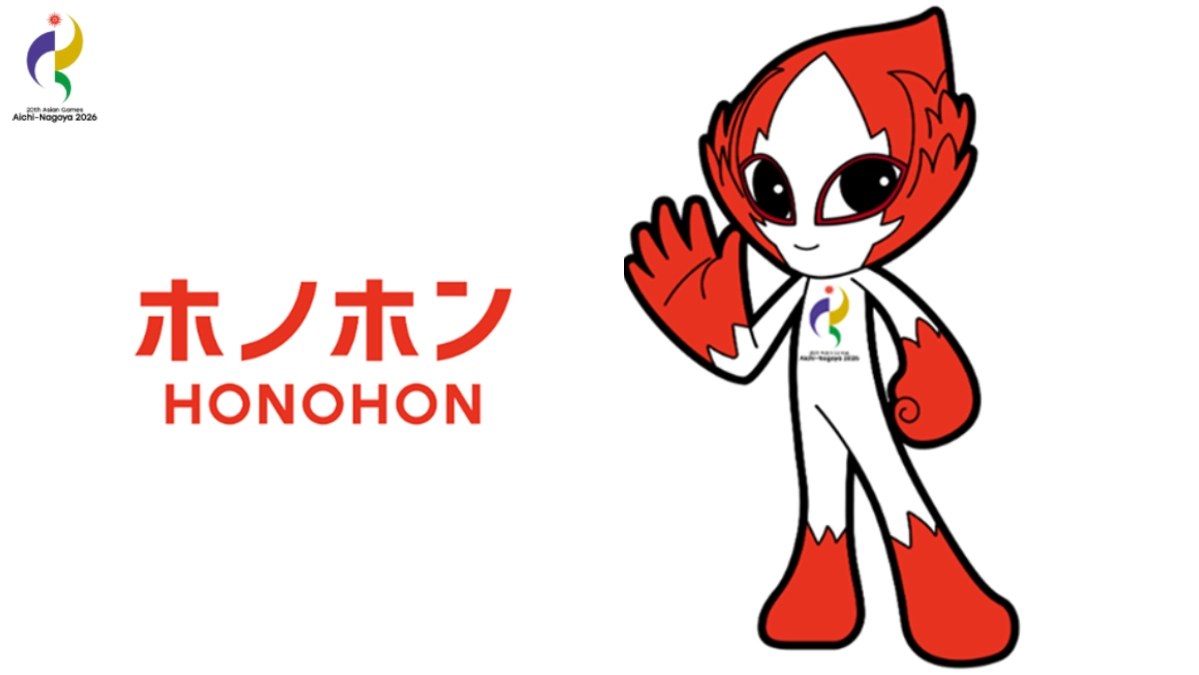
| Mascot | Host City | Year |
|---|---|---|
| Hodori | Seoul | 1986 |
| Panpan | Beijing | 1990 |
| Five Rams | Guangzhou | 2010 |
| Honohon | Aichi-Nagoya | 2026 |
The Games have also featured opening ceremonies, torch relays, and cauldron-lighting ceremonies that have become important traditions.
The historic motto associated with the Asian Games is “Ever Onward.”
Major Controversies and Challenges in Asian Games History
Asian Games history has also been influenced by political tensions. The 1962 Jakarta Asian Games became controversial after Indonesia refused entry to athletes from Israel and Taiwan. The incident led to serious consequences involving Indonesia and the Olympic movement.
The 1970 Games were also affected when Seoul withdrew as host, citing security concerns connected with North Korea. Bangkok stepped in to host the event. Similarly, Pakistan withdrew from hosting the 1978 Asian Games because of financial difficulties, and Bangkok again became the replacement host.
These political and organizational challenges eventually contributed to changes in the Asian Games governing structure. The Asian Games Federation was replaced by the Olympic Council of Asia (OCA), which was established in 1981 and took over from the federation at the 1982 Asian Games. The Hangzhou Games, originally scheduled for 2022, were postponed until 2023 because of the COVID-19 pandemic, marking the first postponement of the Asian Games.
Asian Games 2023 Hangzhou: Major Highlights
The 19th Asian Games were originally scheduled for 2022 but were held in Hangzhou, China, in 2023 after the COVID-19 postponement. China dominated the medal table with 201 gold medals. For India, the Games were historic, with the country winning a record 107 medals, including 28 gold medals. Major Indian achievements included India’s first Asian Games badminton men’s doubles gold, strong performances in shooting and athletics, three gold medals for Jyothi Surekha Vennam, India’s record 107-medal haul, and esports becoming a medal sport.
Asian Games 2026 and Beyond
The 20th Asian Games will take place in Aichi-Nagoya, Japan, from 19 September to 4 October 2026. Japan is hosting the Asian Games for the third time after Tokyo in 1958 and Hiroshima in 1994. The 2026 edition is scheduled to feature 46 nations and territories, 43 sports, 71 disciplines and 469 events.
The Asian Para Games will follow in the same region in October 2026.
Looking beyond 2026, the Asian Games will continue their expansion across the continent. Doha, Qatar, is scheduled to host the 2030 edition, followed by Riyadh, Saudi Arabia, in 2034. These future editions reflect the continued geographical reach and growing importance of the Asian Games in international sport.
Asian Games vs Olympics: Key Differences
The Asian Games and Olympic Games share several similarities, including four-year cycles, opening ceremonies, athlete villages, medal events, and torch traditions. However, the main difference is their geographical scope. The Olympic Games are global, while the Asian Games are a continental event for Asia.
The Asian Games also feature several sports that have strong regional importance, including kabaddi, sepak takraw, and wushu. Because of this, the Asian Games provide a unique platform for Asian athletes to compete in sports that may not always have the same prominence at the Olympics.
Why the Asian Games Still Matter
More than seven decades on, Asian Games history remains a rare thread running through the continent’s political, cultural, and economic diversity one that keeps pulling nations together around shared competition every four years. From a war-scarred, newly independent India hosting on a shoestring budget in 1951, through Cold War-era boycotts and suspensions, to a 21st-century Japan showcasing esports and breaking records, the Games have consistently mirrored Asia’s own transformation.
It is the story of how Asian nations came together through sport, evolving from six sports in New Delhi in 1951 into a major continental festival, and with new sports, new host nations, and future editions in Doha and Riyadh already confirmed, the Asian Games are set to remain a defining part of Asia’s sporting identity for decades to come. For athletes across the continent, the Asiad continues to be second only to the Olympics in prestige, and often the biggest stage of their careers.
Asian Games History: Frequently Asked Questions
When was the first Asian Games held?
The first Asian Games were held in New Delhi, India, from 4 to 11 March 1951.
Who started the Asian Games?
Indian IOC member Guru Dutt Sondhi played a leading role in proposing the modern Asian Games concept. The Asian Games Federation was established in 1949.
Which country has hosted the most Asian Games?
Thailand has hosted the Asian Games four times – in 1966, 1970, 1978, and 1998.
How many times has India hosted the Asian Games?
India has hosted the Asian Games twice, both times in New Delhi – in 1951 and 1982.
Which country has won the most Asian Games medals?
China is the most successful nation in Asian Games history in terms of gold medals and overall medal performance.
What was India’s best Asian Games performance?
India’s best medal haul came at Hangzhou 2023, when the country won a record 107 medals – 28 gold, 38 silver and 41 bronze.
Where will the 2026 Asian Games be held?
The 2026 Asian Games will be held in Aichi-Nagoya, Japan, from 19 September to 4 October 2026.
What is the difference between the Asian Games and the Olympics?
The Olympics are a global multi-sport event, while the Asian Games are a continental competition involving Asian nations. The Asian Games also feature several regionally important sports such as kabaddi, sepak takraw, and wushu.
Sources: Olympics.com (official Olympic Movement platform) – India at the Asian Games: History & Medals, Wikipedia – Asian Games (overview & all editions), Wikipedia – 1962 Asian Games (Israel/Taiwan exclusion controversy), Wikipedia – Olympic Council of Asia (formation & governance), Wikipedia – 2026 Asian Games (Aichi-Nagoya details)