
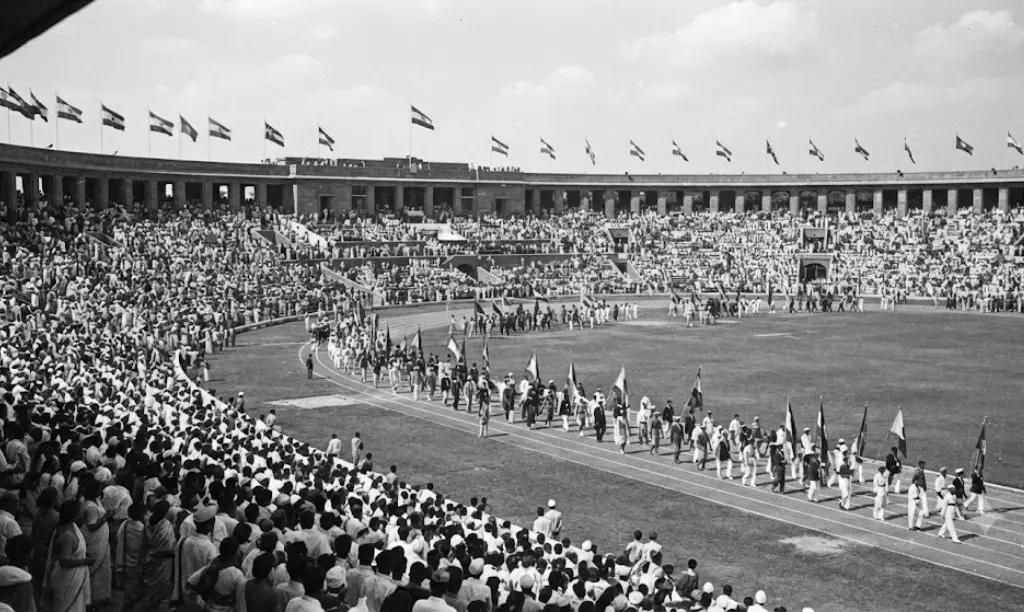
The first Asian Games 1951 marked a historic moment – a nation barely three and a half years into independence, still absorbing the trauma of Partition, still rebuilding its economy, pulled off something few thought possible: it hosted Asia’s first-ever multi-sport games. No blueprint existed. No prior Asian Games had ever been held. What New Delhi built that spring, largely from scratch, became the template every Asiad since has followed. Here’s exactly where it happened, who made it happen, and who showed up.
Where Were the First Asian Games Held?
The first Asian Games were held in New Delhi, India, from 4 to 11 March 1951, at a venue called the National Stadium, today known as the Major Dhyan Chand National Stadium. The stadium itself has an older story: it was originally built in 1933 as the Irwin Amphitheatre, a gift to Delhi from the Maharaja of Bhavnagar, designed by architect Anthony S. DeMillo and opened by Lord Willingdon. Built to hold about 25,000 spectators, it was renamed and substantially renovated ahead of the 1951 Games, expanding capacity to roughly 40,000 and adding a cycling track, a cinder athletics track, a main grass arena, and eight entrance tunnels.
Prime Minister Jawaharlal Nehru personally sanctioned ₹10 lakh from the Prime Minister’s Fund to help finance the upgrade, a serious sum for a country in economic distress at the time. Every sport except swimming, diving, and water polo (held in an adjoining pool) took place inside that one stadium complex.
Which Country Was the First to Host the Asian Games?
India was the first country to host the Asian Games, and it didn’t happen by default. At the 1947 Asian Relations Conference in New Delhi, Indian IOC member Guru Dutt Sondhi pitched the idea of a unified, continent-wide sporting event to Asian leaders still finding their footing after colonial rule. The proposal gathered enough support that the Asian Games Federation was formally established in New Delhi on 13 February 1949, with Delhi unanimously chosen as the first host city on the spot. The Games were originally slated for 1950 but were pushed back a year because preparations simply weren’t ready in time. Not every invited nation showed up. Pakistan, one of the AGF’s founding members, declined to participate because of the Kashmir conflict, and China never responded to its invitation at all, both notable absences from an event explicitly built around the idea of pan-Asian unity.
How Many Countries Participated in the First Asian Games?
Eleven nations took part in the first Asian Games: Afghanistan, Burma (present-day Myanmar), Ceylon (present-day Sri Lanka), India, Indonesia, Iran, Japan, Nepal, the Philippines, Singapore, and Thailand. Between them, they sent 489 athletes competing in 57 medal events across six sports – athletics, aquatics (swimming, diving, and water polo), basketball, cycling, football, and weightlifting. Boxing was seriously considered for the programme but was eventually dropped before the Games began.
The contingents varied wildly in size: host India fielded the largest delegation by far, with 151 athletes, while Ceylon (Sri Lanka) sent the smallest, with just 3. Japan, competing internationally again for the first time since the devastation of World War II, brought a 72-member team. Iran sent athletes to every event on the programme but did not send a single woman.
Inside the Opening Ceremony
India’s first President, Dr Rajendra Prasad, formally opened the Games as chief guest on 4 March 1951, with Nehru also in attendance, in front of roughly 40,000 spectators; a 31-gun salute rang out from the ramparts of Delhi’s Purana Qila to mark the occasion. The Games’ official emblem was a bright, rising red sun with 16 rays, underlined by 11 interlocking rings representing each participating nation. Nehru himself gave the Games their enduring motto, “Ever Onward,” and the ceremonial torch and flag carried from host nation to host nation ever since were presented by the Maharaja of Patiala.
Behind the scenes, organizers had to improvise an athletes’ village on short notice; with almost no hotel capacity in Delhi for nearly 1,000 visiting athletes, officials and coaches, the Army’s Commander-in-Chief, General K. M. Cariappa, stepped in and lent two blocks of Army housing next to the stadium.
Notable Moments and Records From New Delhi 1951
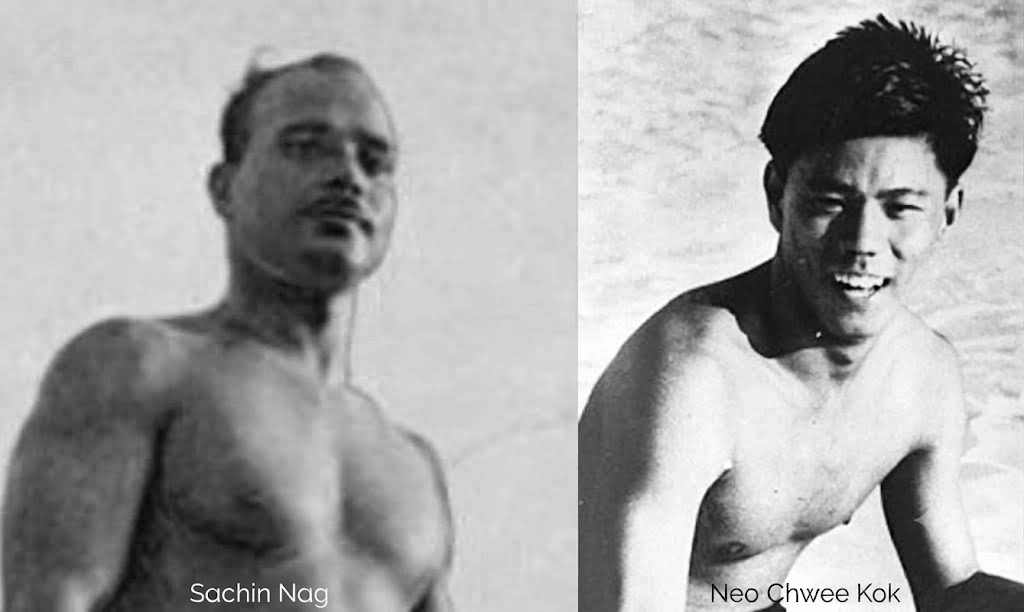
Singapore’s swimmer Neo Chwee Kok became the first-ever Asian Games gold medallist and finished as the Games’ most decorated individual athlete, winning four golds across the 400m, 800m, 1500m freestyle, and 4x100m relay. For India, swimmer Sachin Nag delivered the host nation’s first-ever Asian Games gold, in the 100m freestyle. A curious sidebar to the official programme was the non-medal “Mr Asia” bodybuilding contest, judged on physical development, looks, and personality – India’s Parimal Roy took the title, controversially beating Iranian weightlifting gold medallist Mahmoud Namdjou, who would go on to win two Olympic medals over the following decade.
New Delhi 1951 also remains the only edition in Asian Games history where India has medalled in cycling, with Rohinton Noble and Netai Chand Bysack winning bronze in the men’s sprint and 1km time trial respectively – a record that still stands.
Final Medal Table: 1951 Asian Games
| Rank | Nation | Gold | Silver | Bronze | Total |
|---|---|---|---|---|---|
| 1 | Japan | 24 | 21 | 15 | 60 |
| 2 | India (Host) | 15 | 16 | 20 | 51 |
| 3 | Iran | 8 | 6 | 2 | 16 |
A total of 169 medals were awarded across the six-sport, week-long programme, modest by today’s standards (Aichi-Nagoya 2026 will award medals across 469 events), but historic as the very first continental medal table Asia had ever produced. Complete coverage of that milestone is available on Olympics.com’s official retrospective on New Delhi 1951.
Why New Delhi 1951 Still Matters
The 1951 Asian Games weren’t organized by Nehru’s government directly – they were pulled together by a coalition of sports administrators, policymakers, and private patrons determined to put newly independent India on the world’s sporting map, just four years after independence and barely six after the Second World War ended. For a country still absorbing the Partition refugee crisis and operating on a tight post-independence budget, staging an international multi-sport event of this scale was, by any measure, an audacious bet, and it paid off.
It set the template that every Asian Games since, right through to Aichi-Nagoya 2026, has continued to build on. For the complete story of how the Games grew from this single edition into a 46-nation, 43-sport festival, read our full Asian Games History guide.
Frequently Asked Questions
Where were the first Asian Games held?
The first Asian Games were held in New Delhi, India, from 4 to 11 March 1951, at the National Stadium (now the Major Dhyan Chand National Stadium).
Which was the first country to host the Asian Games?
India was the first country to host the Asian Games. New Delhi was unanimously chosen as host when the Asian Games Federation was formed in 1949.
How many countries participated in the first Asian Games?
Eleven countries participated in the first Asian Games: Afghanistan, Burma, Ceylon, India, Indonesia, Iran, Japan, Nepal, the Philippines, Singapore, and Thailand.
How many athletes competed at the first Asian Games?
A total of 489 athletes competed at the first Asian Games, with host nation India fielding the largest contingent (151 athletes) and Ceylon (Sri Lanka) the smallest (3 athletes).
Which country topped the medal table at the first Asian Games?
Japan topped the medal table at the 1951 Asian Games with 60 medals (24 gold, 21 silver, 15 bronze), ahead of host nation India, which finished second with 51 medals.
Sources: Olympics.com (official Olympic Movement platform) – First Asian Games: New Delhi 1951; Wikipedia – 1951 Asian Games