
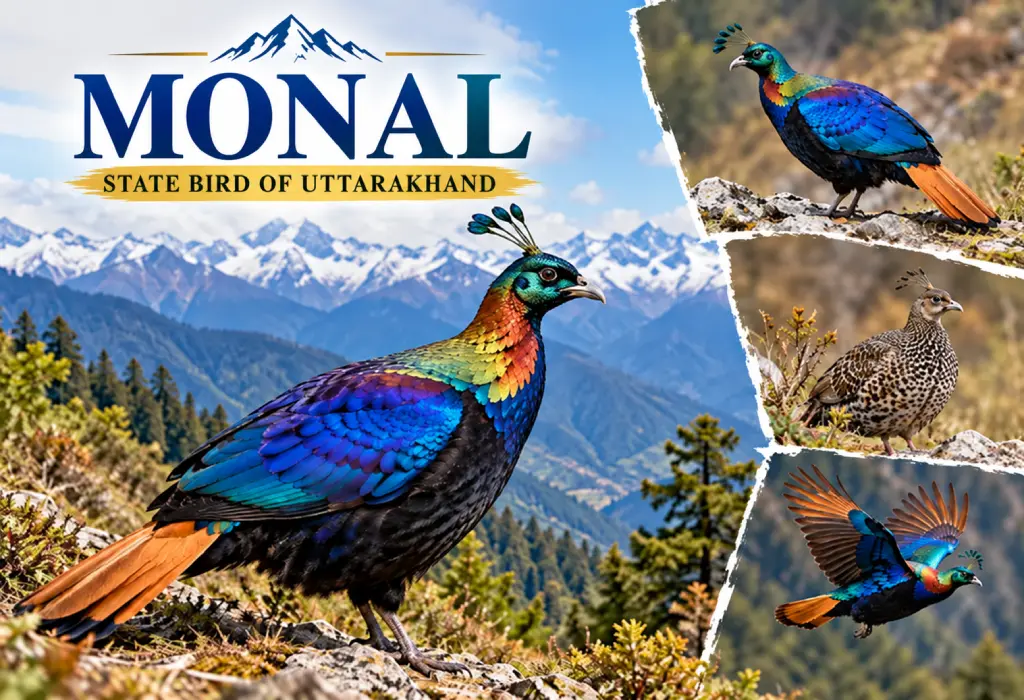
Monal Himalayan Bird of Uttarakhand
The monal himalayan bird is one of the most colourful birds in the world. It lives high in the Himalayas. Its feathers shine in blue, green, purple and copper, almost like a living rainbow.
Many people call it the Himalayan monal. Some also call it the Impeyan monal or Impeyan pheasant. In Nepal, people know it as “Danphe.” It is the national bird of Nepal and the state bird of Uttarakhand in India.
In this guide, you will learn the basics and many small details about this bird. We will cover its looks, habitat, food, migration, breeding, culture, conservation status and where to see it in Uttarakhand.
What Is the Monal Himalayan Bird?
The monal himalayan bird is a large pheasant. Its scientific name is Lophophorus impejanus. It belongs to the Phasianidae family, the same family as peacocks, partridges and junglefowl.
It spends most of its time on the ground. It can fly, but it prefers to walk, dig and glide down slopes. You will mostly find it on steep mountain hillsides.
Quick facts at a glance:
- Common names: Himalayan monal, Impeyan monal, Impeyan pheasant, Danphe
- Scientific name: Lophophorus impejanus
- Family: Phasianidae (pheasants)
- Length: About 70 to 72 cm
- Weight: Around 1.8 to 2.4 kg
- Altitude: Roughly 2,000 to 4,500 metres
- Diet: Roots, tubers, insects, seeds, shoots and berries
- IUCN status: Least Concern, but the population is suspected to be decreasing
Meaning of the Name “Monal”
The word “monal” comes from a Hindi word, “munal.” The bird is also called “Impeyan” in honour of Lady Mary Impey. She was the wife of Sir Elijah Impey, a British judge in India in the 1700s. She kept a collection of exotic birds, and the species was named in her honour.
The genus name Lophophorus means “crest-bearer.” That fits well, as the bird wears a crest on its head.
How Does the Monal Himalayan Bird Look?
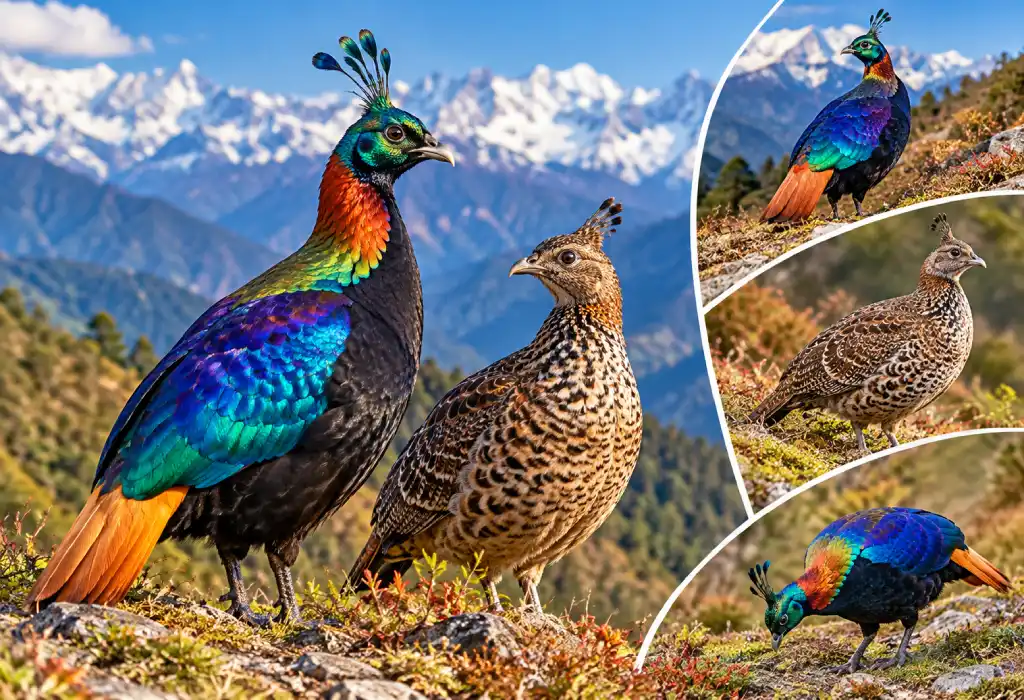
This bird shows a big difference between males and females. Scientists call this sexual dimorphism.
Male Monal
The male is the star of the show. His feathers have a metallic shine, and the colours change in sunlight.
- Head: A metallic green crest with spoon-shaped tips
- Neck and back: Copper, purple and bronze shades
- Wings and body: Deep blue and green
- Rump: A bright white patch, easy to see in flight
- Tail: Rich cinnamon or reddish brown
- Breast and belly: Dark, almost black
The male does not have a long, fan-shaped tail like a peacock. Still, his shine is hard to beat.
Female Monal
The female looks plain next to the male. She has brown and buff, streaky feathers. She also has a white patch under the chin, a short crest and a pale blue ring around the eye. This dull colour is useful. It helps her hide on the ground while she sits on her nest.
Young Birds
Young monals look like the female. Young males slowly gain their bright colours as they grow. Sexual maturity comes at around two years.
Where Does the Monal Himalayan Bird Live?
The monal himalayan bird lives along the Himalayan range. Its home stretches from eastern Afghanistan through Pakistan, India, Nepal and Bhutan. It also reaches China (southern Tibet) and Myanmar.
In India, you can find it in:
- Jammu and Kashmir
- Himachal Pradesh
- Uttarakhand
- Sikkim
- Arunachal Pradesh
Preferred Habitat
This bird loves high mountain forests. It likes:
- Oak, deodar and rhododendron forests
- Conifer forests with bamboo
- Steep, rocky and grassy slopes
- Alpine meadows
- Open patches near the tree line
Does the Monal Himalayan Bird Migrate?
Yes, but not like most birds. The monal himalayan bird does not fly thousands of kilometres. It moves up and down the mountain with the seasons. Scientists call this altitudinal migration or vertical migration. Snow, food and shelter decide when it moves.
Summer: Moving Up
In spring and summer, the snow melts. Fresh grass, shoots and insects appear on high slopes. The monal climbs to alpine meadows and open slopes, even above the tree line. Breeding happens in these high areas.
Winter: Moving Down
In winter, heavy snow covers the food. The bird then comes down to forests of oak, rhododendron and conifer. In places like the Great Himalayan National Park, it can drop as low as about 2,000 metres. Here it can still dig for roots and tubers, and the trees give it cover.
When Does It Happen?
- March to May: The bird moves up as snow melts.
- October to December: It moves down as snow arrives.
The exact timing changes every year. It depends on snowfall and temperature.
What Does the Monal Himalayan Bird Eat?
The monal is an expert digger. It uses its strong, curved beak and claws to dig into soil and snow. Its food depends on the season.
Main foods include:
- Roots and tubers
- Insects and grubs
- Seeds and nuts
- Berries
- Tender leaves and shoots
In winter, food is scarce. The bird then relies more on roots and plants buried under the snow. It usually feeds in the early morning and late afternoon. During the day, it may rest in shady spots.
Behaviour and Daily Life
The monal himalayan bird is shy and alert. It often runs or flies off from a long distance when it sees a person. This is why close views are rare.
During the breeding season, you may see it alone or in pairs. In winter, it often forms larger groups. These groups roost together for safety and warmth.
At night, it roosts on tree branches. This keeps it safe from ground predators. When scared, the bird runs uphill or glides down the slope. Gliding is its fastest escape.
The Monal’s Call
The call is loud and sharp. It is a clear, far-carrying whistle that echoes across mountain valleys. Males call more during the early breeding season to attract females.
Breeding and Nesting
The breeding season runs from around April to August. The exact timing changes with altitude and weather.
During this time, the male performs a courtship display. He fans his tail, bobs his shoulders and struts around the female. His shining colours play a big role here.
Nest and Eggs
- The female makes a simple nest on the ground.
- She chooses a spot under a rock, a boulder or a shrub.
- She usually lays 3 to 5 eggs.
- She sits on the eggs alone for about 27 to 28 days.
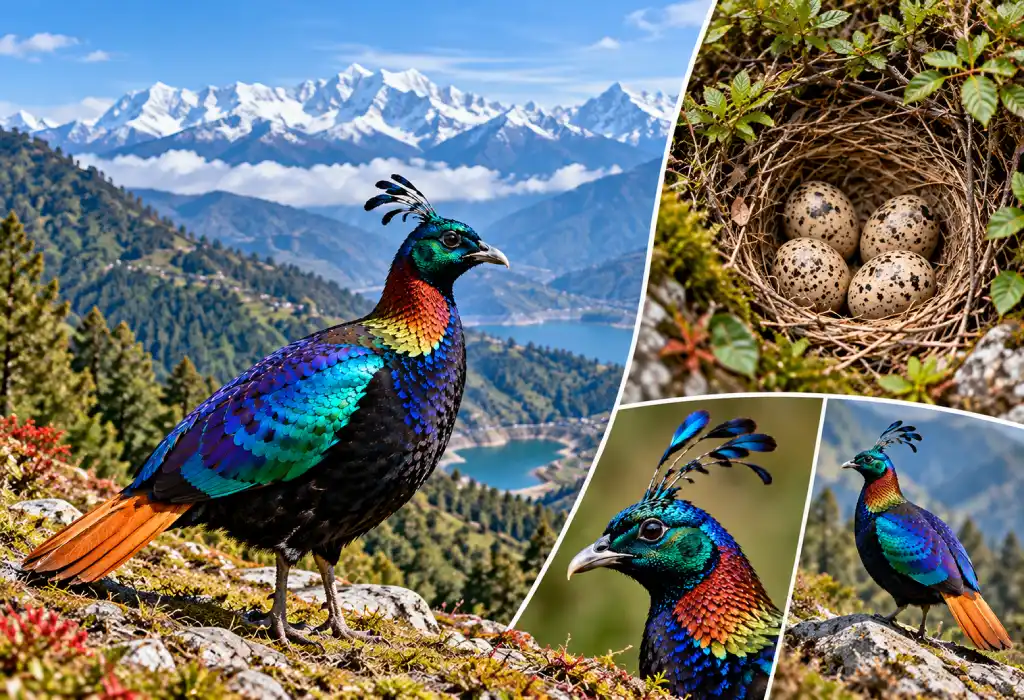
The male does not sit on the eggs. The chicks can walk and follow their mother within hours of hatching. They learn to feed on their own and stay close to her for safety.
Monal Himalayan Bird in Uttarakhand
Uttarakhand is one of the best states in India to see this bird. You can see the monal mostly in the Garhwal Himalaya, and also in parts of Kumaon.
Cultural Importance in Uttarakhand
The monal himalayan bird is the official state bird of Uttarakhand and a proud symbol of the state’s mountain wildlife. Across the Himalayas, the bird also features in local folklore and traditional art.
In the past, monal plumes decorated traditional caps in parts of the Himalayas, such as Himachal Pradesh. Today, the bird is protected under Schedule I of the Wildlife (Protection) Act, 1972. Hunting it or trading its feathers is illegal.
Pilgrims and trekkers often spot it near Tungnath and Kedarnath. This is only because they share the same high forests. It is a shared location, not a religious role.
Monals are found in several districts of the state. You can also explore our guides to Almora district, home to Binsar, and Uttarkashi district, which includes Gangotri and Govind Pashu Vihar, to plan your trip to monal country.
Where to Find the Monal Himalayan Bird in Uttarakhand
- Chopta–Tungnath (Rudraprayag and Chamoli): This is the most famous spot. Many bird watchers and trekkers see monals here, especially on the Tungnath and Chandrashila trail.
- Kedarnath Wildlife Sanctuary (Kedarnath Musk Deer Sanctuary): Its oak and rhododendron forests suit the bird well. The Madmaheshwar valley here is quieter and good for sightings.
- Other high forests: Areas like Govind Pashu Vihar, Gangotri, the Nanda Devi region, Binsar and the Munsiyari–Pindari belt are also reported as monal habitat.
Chopta is usually the easiest place for a first-time visitor.
Monal Himalayan Bird in Other Regions
The monal is not limited to Uttarakhand. Each region has its own link with the bird.
Himachal Pradesh
In Himachal Pradesh, you can see the bird in the Great Himalayan National Park, especially in the Tirthan and Sainj valleys. It usually stays between about 2,500 and 4,000 metres here.
The monal was once Himachal’s state bird. In 2007, the Western Tragopan (Jujurana) replaced it. The state has also banned the use of monal plumes on caps and brooches.
Nepal
In Nepal, people call it “Danphe.” It is the national bird and appears in all the Himalayan protected areas, including Sagarmatha, Langtang, Rara, Shey Phoksundo and Khaptad National Parks, and the Annapurna Conservation Area.
Nepal’s Department of National Parks and Wildlife Conservation estimates the national population at around 3,500 to 5,000 birds. Its cultural place in Nepal is much stronger than in other regions. People celebrate it in folk songs and art, and it stands for the country’s Himalayan nature and identity.
Sikkim, Arunachal Pradesh and Jammu & Kashmir
The bird also lives in the high forests of these regions. It is mainly known for wildlife and bird watching.
Is the Monal Himalayan Bird Endangered or Extinct?
No. The monal himalayan bird is not extinct. It is also not listed as endangered worldwide.
The IUCN Red List rates it as Least Concern. This means it is still fairly widespread. But the story does not end here.
The Real Picture
- The global population is not exactly known.
- The population is suspected to be decreasing.
- The State of India’s Birds report points to a decline in India over the long term, though the latest estimates are uncertain.
- In Nepal, it is regionally listed as Near Threatened.
- A close relative, Sclater’s monal, is listed as Vulnerable.
So the monal is safe for now. But it needs care so that it does not slip toward a higher risk category.
Legal Protection
- India: Schedule I of the Wildlife (Protection) Act, 1972. This is the highest level of protection.
- International: CITES Appendix I, which restricts international trade.
- Nepal: Protected under the National Parks and Wildlife Conservation Act.
Why Is the Monal Himalayan Bird Declining?
Several problems put this bird at risk.
- Hunting and poaching: People hunt it for meat and its shiny feathers. Illegal plumes still turn up in markets despite the bans.
- Habitat loss: Roads, buildings, farms and logging cut into its forest home.
- Overgrazing and herb collection: Livestock damage the grass. People who dig for medicinal plants disturb the soil and nesting areas.
- Noise and tourism: A study in Kedarnath Wildlife Sanctuary found that monals at noisy, busy Chopta changed their calls compared to those in quieter Madmaheshwar.
- Climate change: Warmer weather may shift its habitat higher. In the end, space runs out at the top of the mountain.
How Can We Protect the Monal Himalayan Bird?
Everyone can help. Small steps add up.
- Follow the law. Never hunt, trade or buy monal feathers.
- Respect forest rules. Stay on marked trails in sanctuaries.
- Keep noise low. Avoid loud music and honking in bird habitat.
- Keep your distance. Do not chase, feed or disturb the birds.
- Do not litter. Carry your waste back from mountain areas.
- Report poaching. Inform the forest department if you see illegal hunting.
- Choose eco-friendly tourism. Pick local guides and responsible homestays.
- Protect forests and meadows. Support tree planting and controlled grazing.
- Spread awareness. Share what you know about the bird.
Local communities matter most. When villagers gain from bird tourism, they protect the habitat better.
Why the Monal Matters
This bird is more than a pretty face. Its digging loosens soil. It feeds on insects and helps keep their numbers in check. Its health also shows the health of high-altitude forests.
Tips for Spotting the Monal Himalayan Bird
Want to see this bird yourself? You need patience, good binoculars and an early start.
- Go early in the morning, right after sunrise.
- Visit between March and June for better chances. Males are active then.
- Walk slowly and stay quiet.
- Listen for the loud whistle first.
- Hire a local guide who knows the trails.
A Jewel Worth Saving
The monal himalayan bird is a true jewel of the mountains. Its shining feathers, loud call and shy nature make it special. It is also a vital part of the Himalayan forest.
It is not extinct, and it is not globally endangered. But pressure from hunting, habitat loss, noise and climate change is real. With care and awareness, we can keep the monal thriving in the wild.
At the Uttarakhand Sports Foundation, we love sharing everything that makes Uttarakhand proud. Read more stories on our blog.
Next time you travel to the hills, keep your eyes open. You might catch a flash of blue and green on a high slope.
One Response