
Uttarakhand Foundation Day: Uttarakhand Sthapna Diwas, History and Struggle
- Written by: UKSports
- Published on:
- 7 min
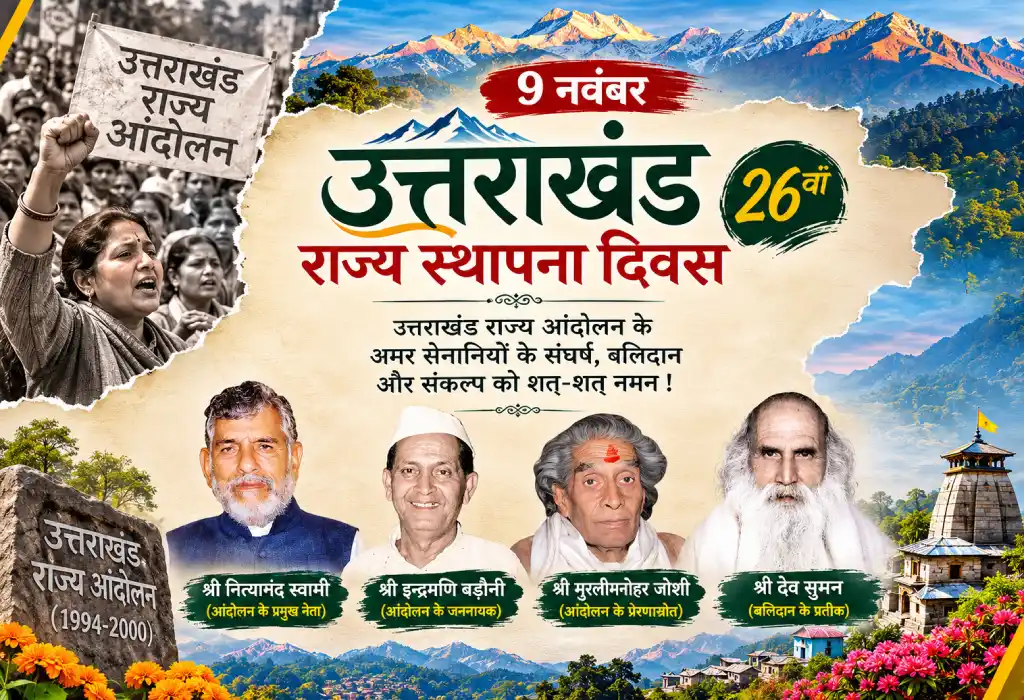
Table of Contents
Uttarakhand Sthapna Diwas:
Uttarakhand Sthapna Diwas (उत्तराखंड स्थापना दिवस) is the day the state came into existence. It is celebrated every year on 9 November. On this day in 2000, Uttarakhand became the 27th state of India. It was carved out of Uttar Pradesh after a long public movement. In 2026, it falls on Monday, 9 November.
This guide explains when the demand for a separate state began, who led the movement and what the people suffered to win their own state.
What Is Uttarakhand Sthapna Diwas?
Uttarakhand Sthapna Diwas, also called Uttarakhand Foundation Day or Uttarakhand Divas, marks the birth of the state. It reminds people of the sacrifices made for a separate hill state.
Quick answer:
- Date: 9 November every year
- Year of formation: 2000
- Rank: 27th state of India
- Carved out of: Uttar Pradesh
- Winter (interim) capital: Dehradun
- Summer capital: Gairsain (Bhararisain), announced in 2020
The state’s old name was Uttaranchal. It was renamed Uttarakhand on 1 January 2007.
When Did the First Andolan for Uttarakhand Start?
There is no single agreed date. Sources mention different starting points. The year most often quoted is 1897, which many sources describe as the first demand for a separate Uttarakhand. Other accounts treat 1952, when the Communist Party of India raised the demand, as the first clear political demand. In any case, the demand grew slowly over the next hundred years.
Here are the key milestones:
- 1897: The year commonly cited for the first demand for a separate hill state.
- 1916: Young activists formed the Kumaon Parishad. It began with social and economic issues of the hills and later added political goals.
- 1938: The demand for a hill state was raised at a Congress session in Srinagar (Garhwal) in May 1938. Jawaharlal Nehru is said to have favoured the cause.
- 1940: At the Haldwani conference, Badri Datt Pandey asked for special status for the hill region. Anusuya Prasad Bahuguna suggested Kumaon and Garhwal as separate units.
- 1952: The Communist Party of India passed a resolution moved by P.C. Joshi for a separate hill state.
- 1957: T.T. Krishnamachari, then deputy chairman of the Planning Commission, asked for special attention to the hill region.
- 1970: Prime Minister Indira Gandhi admitted that the hill region needed special care from both the state and the Centre.
- 1979: The Uttarakhand Kranti Dal (UKD) was formed in July. It made statehood a clear political demand.
The Leaders Who Led the Statehood Movement
The Uttarakhand Kranti Dal was set up in 1979 by Bipin Chandra Tripathi, Prof. Devi Datt Pant, Indramani Badoni, Kashi Singh Airy, Diwakar Bhatt and Surendra Kukreti. Prof. Devi Datt Pant, a former vice-chancellor of Kumaon University, chaired the founding convention.
- Indramani Badoni (1925–1999): He is called the “Gandhi of Uttarakhand”. In 1988, he walked 105 days from Tawaghat in Pithoragarh to Dehradun to spread the message door to door. In 1992, he declared Gairsain as the capital on Makar Sankranti. In 1994, he began a fast unto death in Pauri and was jailed in Muzaffarnagar. He died in August 1999, before the state was formed. He received the Uttarakhand Ratna award after his death, in 2016.
- Prof. Devi Datt Pant: He gave the party its early leadership and a strong academic voice.
- Bipin Chandra Tripathi (1945–2004): He was born in Dwarahat, Almora, and stayed a leader of the UKD for many years.
- Kashi Singh Airy (born 1953): He was born in Dharchula, Pithoragarh. He led public agitations as a young leader and later served as an MLA.
- Diwakar Bhatt: He was a founding member and a long-time agitator. He later led a faction of the UKD.
- Surendra Kukreti: He is a senior statehood activist and a founding member.
- Girish Tiwari “Girda” (1945–2010): He was a poet, singer and activist. His songs, such as “Myar Himala”, carried the message of the movement to every village. He was born near Hawalbagh in Almora.
Old Slogans of the Uttarakhand Statehood Movement
Slogans kept the movement alive in every village and town. These two are the most famous:
- “Aaj do, abhi do, Uttarakhand rajya do” (Give us Uttarakhand state today, give it now)
- “Mandua-Jhangora khayenge, Uttarakhand banayenge” (We will eat millets, but we will build Uttarakhand)
The second slogan showed pride in local food, such as mandua (finger millet) and jhangora (barnyard millet), and in the state’s own identity.
The Struggle That Led to Statehood
People of the hills faced many hardships before Uttarakhand Sthapna Diwas became possible. The struggle had causes, a violent peak and a long wait for a decision.
Why Were People Angry?
- Distance from Lucknow: Decisions for the hills were taken far away in the plains.
- Weak facilities: Roads, schools and hospitals in the mountains were poor.
- Few jobs: Many young people left their villages for work in the plains.
- Reservation order of 1994: In 1994, the Uttar Pradesh government moved to extend OBC reservation in jobs and education. The hills had a very small OBC population, so people feared losing jobs and seats in colleges. This order became the trigger.
The 1980s: Building the Movement
- 1987: At its convention in Karnaprayag, the UKD called for a separate state. In November, the party passed a resolution for the new state and also asked to include Haridwar in it.
- 1988: Indramani Badoni walked 105 days from Pithoragarh to Dehradun under the UKD banner and urged people door to door to back a separate state.
1994: The Year of Sacrifice
Students, women, government employees and ex-servicemen joined the protests. Women took a prominent part in the marches. Many people lost their lives in police action. These events shocked the whole country.
- Pauri (8 August 1994): Jeet Bahadur Gurung is remembered as the first martyr of the movement.
- Khatima (1 September 1994): Police firing killed seven activists. Many call it one of the darkest days of the movement.
- Mussoorie (2 September 1994): A march against the Khatima firing ended in police firing at Jhulaghar. Six protesters, including two women, were killed, and a police officer also died.
- Rampur Tiraha, Muzaffarnagar (1–2 October 1994): About 7,000 people were going to Delhi for a rally organised by the Uttarakhand Samyukta Sangharsh Samiti (USSS), a coalition headed by the UKD. Police stopped them near Rampur Tiraha and opened fire. Reports give the death toll as six or seven, and women activists were allegedly molested and assaulted. The case dragged on for decades. In July 2026, a special CBI court in Muzaffarnagar convicted three former policemen for planting fake weapons to frame the activists.
- 3 October 1994: Anger spread across the hills. Three people died in police firing in Dehradun. Two protesters were beaten to death in Kotdwar. A man named Pratap Singh was shot dead in Nainital.
- Srinagar (November 1994): Activists began a fast unto death at Sriyantra Tapu on 7 November. On 10 November, police action there left two young men dead. Their bodies were later found in the Alaknanda river.
Strikes, Fasts and Talks
The movement was not only about marches. UKD leaders went on fasts unto death. State government employees stopped work for about three months. On 27 October 1994, Union Home Minister Rajesh Pilot held talks with the activists.
From Promise to Law (1991–2000)
- 1991: The Uttar Pradesh government sent a proposal for a separate state to the Centre. No decision came.
- 1994: A committee headed by Ramashankar Kaushik recommended a separate hill state with Gairsain as its capital.
- 15 August 1996: Prime Minister H.D. Deve Gowda announced the new state from the Red Fort.
- 1998: The Vajpayee government sent the Uttaranchal Bill to the Uttar Pradesh assembly. The assembly passed it with changes.
- 27 July 2000: The Uttar Pradesh Reorganisation Bill was introduced in Parliament. The Lok Sabha passed it on 1 August, and the Rajya Sabha passed it on 10 August 2000.
- 28 August 2000: President K.R. Narayanan approved the bill.
- 9 November 2000: The new state came into existence.
On Uttarakhand Sthapna Diwas, people honour the martyrs, known as Rajya Andolankari.
Gairsain: The Summer Capital
The hill people had long wanted Gairsain as the capital, a demand Indramani Badoni and the Kaushik committee both backed. Dehradun stayed the interim capital after 2000. In 2020, the state announced Gairsain (Bhararisain) as the summer capital, while Dehradun remains the winter capital.
How Is Uttarakhand Sthapna Diwas Celebrated?
The day starts with flag hoisting and official speeches. Then people take part in many events:
- Cultural programmes with Garhwali and Kumaoni folk songs and dances
- Tributes to the martyrs of the statehood movement
- Exhibitions on local crafts, food and tourism
- Inauguration of new development projects
- School and college events, quizzes and essay contests
Many people living outside the state also host get-togethers in other cities.
Uttarakhand Foundation Day 2025: The Silver Jubilee
The year 2025 was special. The state celebrated its 25th Foundation Day on Sunday, 9 November. Prime Minister Narendra Modi inaugurated and laid the foundation stones for projects worth more than ₹8,000 crore at the Forest Research Institute in Dehradun. A commemorative postal stamp was also released.
Uttarakhand Sthapna Diwas 2026
In 2026, the state will mark its 26th Foundation Day on Monday, 9 November. Expect flag hoisting, cultural events and tributes to the Rajya Andolankari across the districts.
Read more about Uttarakhand: Uttarakhand district map, destructive flash floods in Uttarakhand, the Monal, the Himalayan bird, what is the capital of Uttarakhand, how many districts are in Uttarakhand, Dehradun in India map, the official state language of Uttarakhand, Uttarakhand population, the pin codes of Uttarakhand, the Uttarakhand slogan and what is Uttarakhand’s old name.