
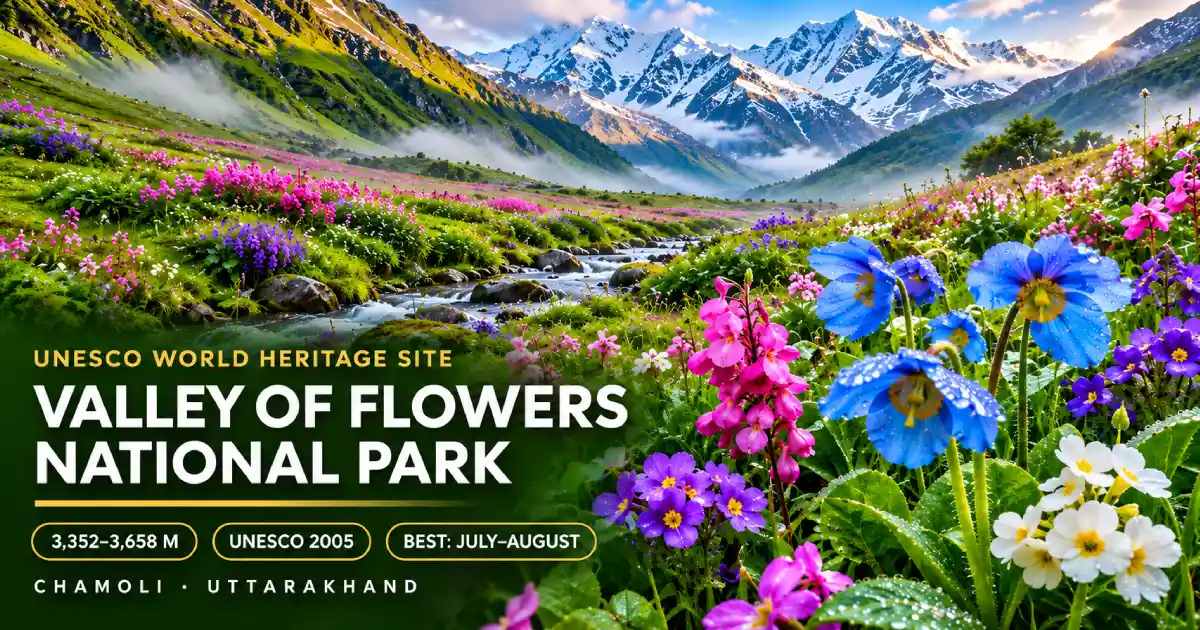
Valley of Flowers National Park is a high-altitude alpine valley in Chamoli district, Uttarakhand, spread over 87.50 sq km at roughly 3,352 to 3,658 m above sea level. It was declared a national park in 1982 and added to the UNESCO World Heritage Site that began with Nanda Devi in 2005. The valley stays under snow for most of the year and opens to visitors from 1 June, with the flowers at their best from mid-July to mid-August. You reach it on foot from Govindghat via Ghangaria, and a Forest Department permit is compulsory. Below you will find the history, the flowers, the permit rules, the best time to go and how the trek works.
What Is Valley of Flowers National Park?
A group of lost mountaineers walked into this valley by accident in 1931, and what they found was so unusual that they named it on the spot. Nobody had to invent the name. The meadows really are covered in flowers for a few weeks of the year, and the rest of the time the valley sleeps under deep snow.
The park lies in the Chamoli district of the Garhwal Himalaya, in the Bhyundar valley, along the Pushpawati river. It is the second core zone of the Nanda Devi Biosphere Reserve, and it forms one UNESCO site with Nanda Devi National Park. It is also one of the six parks in our guide to the national parks in Uttarakhand.
- Location: Bhyundar valley, Chamoli district, Uttarakhand
- Area: 87.50 sq km, about 8 km long and 2 km wide
- Altitude: roughly 3,352 to 3,658 m on the valley floor, with Gauri Parbat (6,719 m) as the highest point in the park
- National park since: 1982
- UNESCO: added to the World Heritage Site in 2005
- Open season: from 1 June, usually until the end of October
- Base village: Ghangaria
The Valley That Was Found by Accident
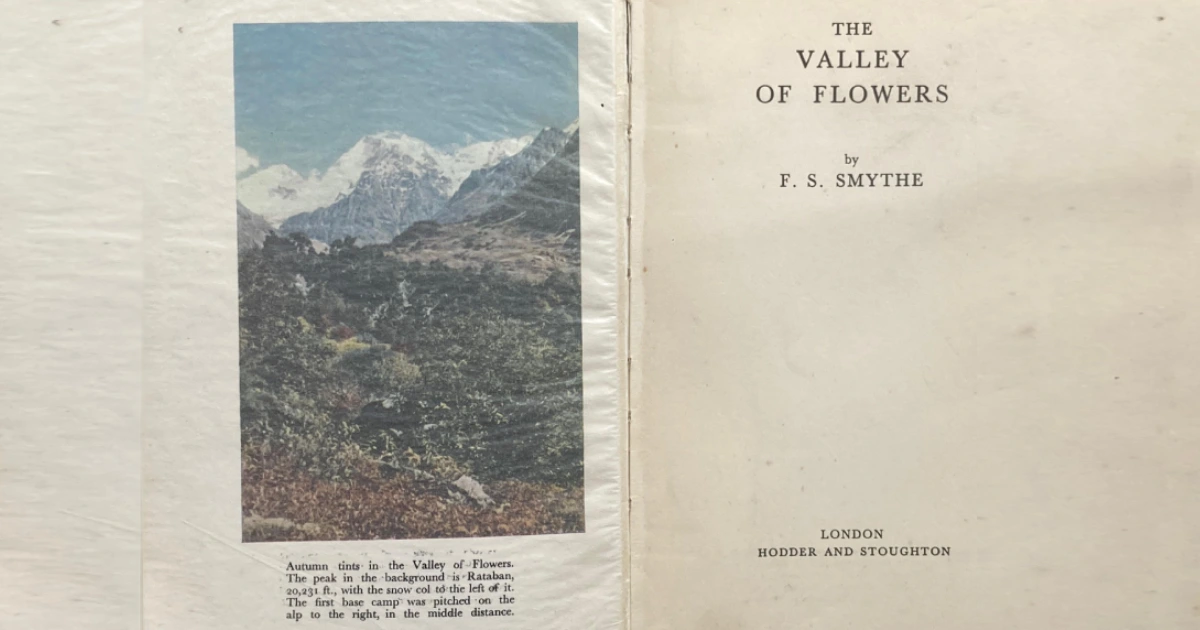
In 1931, the British mountaineers Frank Smythe, Eric Shipton and R. L. Holdsworth were coming back from a successful climb of Mount Kamet when they lost their way and walked into a valley full of alpine flowers. Smythe named it the Valley of Flowers and, in 1938, published a book with the same title. That book put the place on the world map.
In 1939, a British botanist, Joan Margaret Legge, came to the valley to study its flowers. While crossing rocky slopes to collect plants, she slipped and died, on 4 July 1939. Her sister later came to the valley and put up a memorial near the spot, which many trekkers still visit.
The people of the area knew the valley long before any of this. Local belief held that it was a place of fairies and gods, and that those who went too far in might never return.
Flowers You Can See in the Valley of Flowers
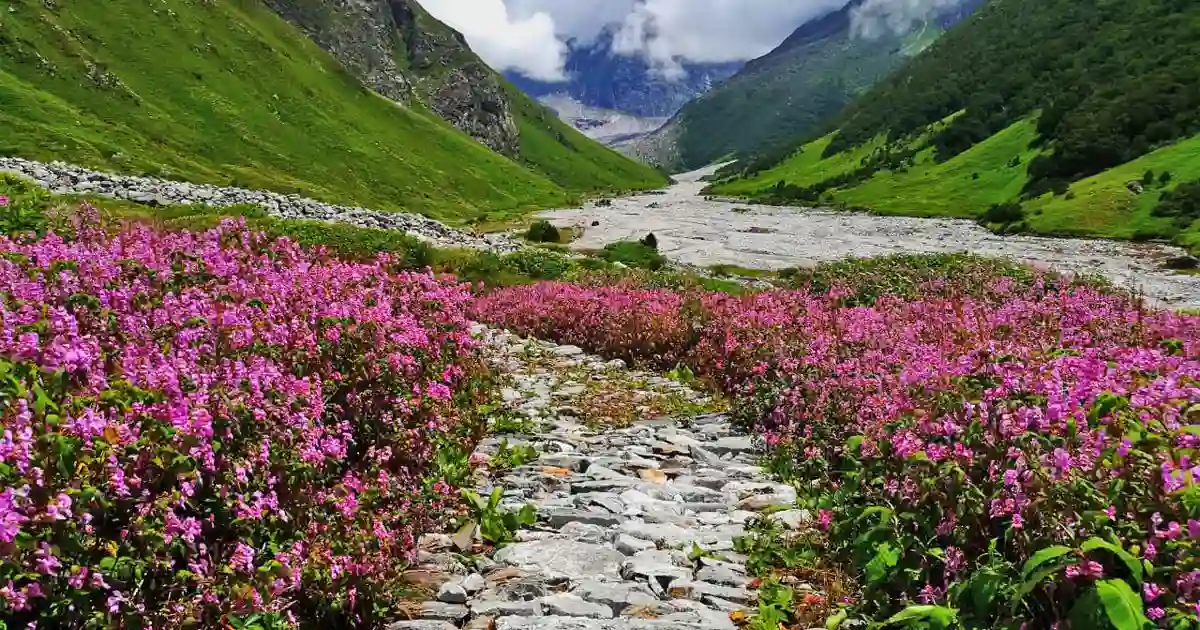
The colours change as the season moves on. Early visitors see primulas and wild roses, and by July and August the meadows fill with a much wider mix. Some of the best-known flowers are:
- Blue poppy (Meconopsis aculeata): probably the most famous flower of the valley
- Cobra lily: a dramatic hooded flower you will spot on damp slopes
- Primulas, anemones, potentillas and Himalayan balsam: the carpet that gives the meadows their colour
- Brahma Kamal (Saussurea obvallata): the state flower of Uttarakhand, though it grows mostly on the higher reaches rather than on the valley floor
More than 500 species of flowering plants have been recorded here. The first week of August, according to botanical accounts, is when a pink wave of Impatiens washes over parts of the valley.
Wildlife in the Valley of Flowers
Flowers are the headline, but the valley is part of a protected Himalayan landscape with its own animals. The Himalayan black bear, brown bear, musk deer, bharal (blue sheep) and snow leopard are all listed among the mammals of the area, and sightings are rare. The Himalayan monal, the state bird of Uttarakhand, lives in these high forests too, and you can read about it in our guide to the Himalayan monal. Most visitors will see butterflies and birds long before they see any large animal.
Best Time to Visit Valley of Flowers
The park opens on 1 June every year, and it is usually open until the end of October. That does not mean every week is equally good, though.
- June: the season begins. There are fewer flowers and often leftover snow on the trail, but also fewer people.
- Mid-July to mid-August: the peak bloom, and the period most people mean when they ask for the best time to visit the Valley of Flowers in Uttarakhand. It is also the heart of the monsoon, so rain is part of the deal.
- September to October: the flowers thin out and the meadows turn to autumn colours. The weather settles, but the show is quieter.
The park is closed for the rest of the year because of snow, so there is no winter visit. The exact closing date can change from year to year, so check it on the official portal before you book anything.
Valley of Flowers Weather
Mountain weather here changes quickly. Mornings can be clear and bright, and by afternoon mist or rain may roll in, especially during the monsoon months of July and August. Ghangaria sits at about 3,049 m, so evenings and early mornings there can feel cold even in summer. Pack a rain jacket or poncho, warm layers and sturdy shoes with good grip, and check the local weather and road conditions before you set out, since landslides can affect the route to Govindghat.
Valley of Flowers National Park Tickets and Permit
You cannot walk into the valley without a permit. Online registration for the national park is compulsory and was started in 2025, and the official website of the Nanda Devi National Park Forest Division links to the Valley of Flowers permit portal. Permits are also issued at the Forest Department counter in Ghangaria.
- Validity: a permit is valid for three days from the day of entry.
- Fee: the fee is different for Indian and foreign visitors, and sources quote different amounts for 2026, so check the exact figure on the portal.
- ID proof: foreign nationals need a passport. Indian visitors can use a voter ID, PAN card or Aadhaar.
- Children: minors are allowed with an adult guardian.
- Daily limit: several tourism guides mention a limit of about 300 visitors a day, in force since 2017.
- Entry timings: the gate opens at 7:00 AM and the last entry is at 2:00 PM. Plan to start walking back by about 1:00 PM, so that you are out of the valley by 5:00 PM.
- No overnight stay: camping and staying inside the national park are not allowed.
How to Reach Valley of Flowers and the Trek From Govindghat
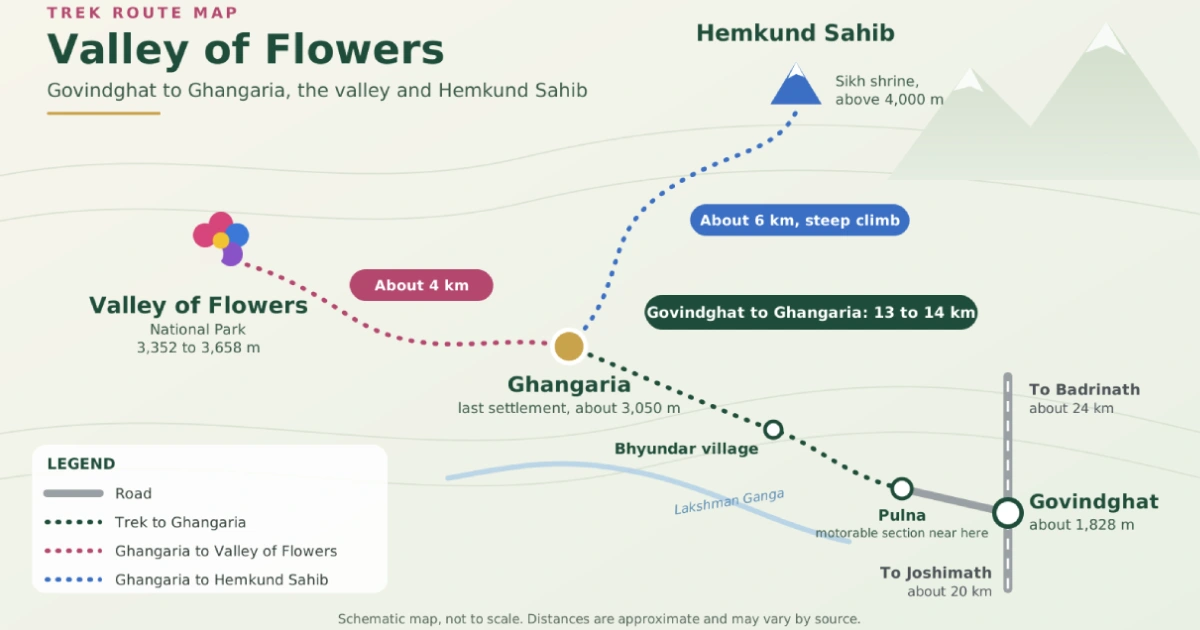
The journey starts at Govindghat, a roadside village near Joshimath on the way to Badrinath, about 24 km before the shrine. If you are combining the two places, our guide to the Shri Badrinath Dham Temple covers the route. Joshimath is about 20 km from Govindghat, and from Rishikesh the road to Joshimath is roughly 255 km, a long day’s drive.
From Govindghat, the trek runs along the Lakshman Ganga to Ghangaria, the last settlement, which is roughly 13 to 14 km away. Part of this stretch can be done by pony or on a short motorable section near Pulna, depending on current road conditions. The valley entrance lies a few kilometres beyond Ghangaria, and the walk in is rated easy compared to the climb up from Govindghat. Most people stay a night in Ghangaria, make the valley trip the next day, and give themselves time to walk back down.
You can see all of the districts that form this part of the state on our Uttarakhand district map.
Where to Stay Near Valley of Flowers
There is no accommodation inside the park. The usual base is Ghangaria, a small village where you will find private lodges and hotels and a handful of simple restaurants serving mostly vegetarian North Indian food. There are no eating places in the valley itself, and a full visit takes anywhere from five to eight hours, so carry a packed lunch, water and snacks. Whatever you take in, carry out. At the entry point you are asked to declare plastic bottles, and littering is taken seriously.
Hemkund Sahib and the Valley of Flowers
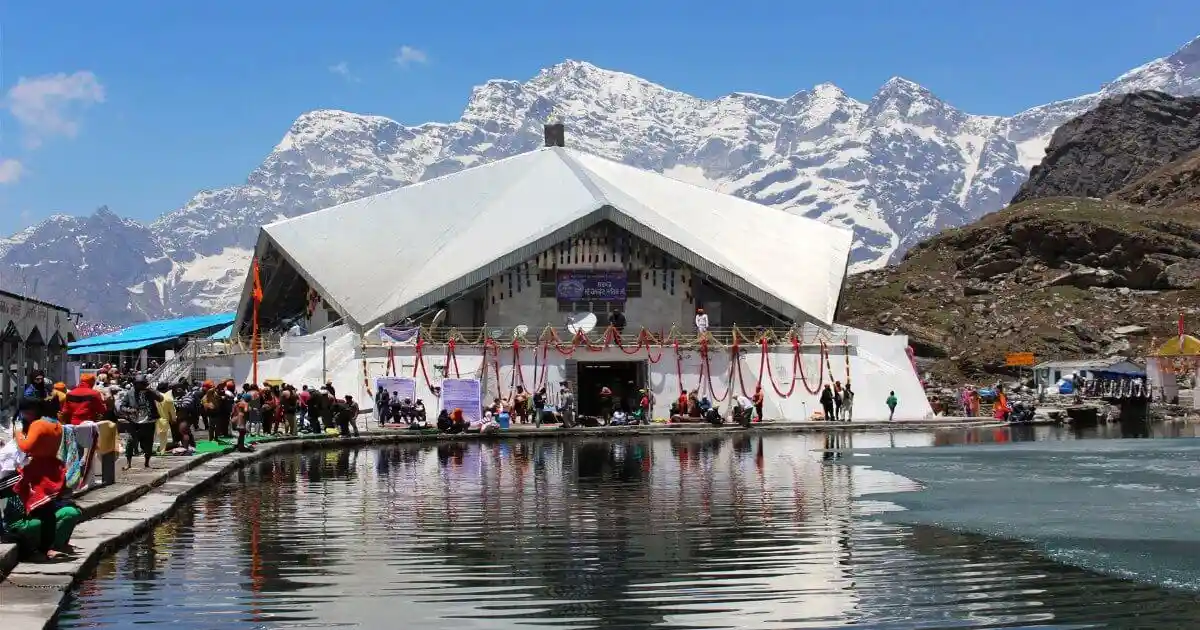
Many travellers search for Hemkund Sahib and the Valley of Flowers together, and for good reason. The Govindghat to Ghangaria trail is shared. At Ghangaria, the path splits: one branch climbs to the valley, and the other climbs to Hemkund Sahib, a Sikh shrine about 6 km from Ghangaria at an altitude of more than 4,000 m. The climb is steep, and thousands of pilgrims walk it every season.
Treat them as two separate day trips from Ghangaria. Trying to do both in one day is exhausting, and the valley entry cut-off of 2:00 PM leaves little room. Check the opening dates for Hemkund Sahib as well, because the shrine has its own season.
Rules to Follow in the Valley of Flowers
- Do not pluck flowers or collect plants of any kind.
- Do not litter. Carry all your waste back to Ghangaria.
- Stay on the marked trail, since the meadow is fragile.
- Register and carry your permit for the full three days.
- Leave on time. Turn back around 1:00 PM and leave the valley well before evening.
Frequently Asked Questions
Where is Valley of Flowers National Park?
In Chamoli district, Uttarakhand, in the Bhyundar valley of the Garhwal Himalaya.
When does the Valley of Flowers open?
The park opens on 1 June each year and usually stays open until the end of October. It is closed in the snowy months.
What is the best time to visit Valley of Flowers?
Mid-July to mid-August is the peak bloom. It is also monsoon season, so expect rain.
Do I need a permit for the Valley of Flowers?
Yes. Online registration is compulsory, and permits are valid for three days. They are also issued at the Forest Department counter in Ghangaria.
Is Valley of Flowers a UNESCO World Heritage Site?
Yes. It was added in 2005 to the site first inscribed as Nanda Devi National Park, which is now called Nanda Devi and Valley of Flowers National Parks. You can read more on the UNESCO World Heritage Centre page.
Can you stay overnight inside the Valley of Flowers?
No. Camping and overnight stays are not allowed inside the national park, so visitors return to Ghangaria the same day.
How far is Hemkund Sahib from the Valley of Flowers?
Both start from Ghangaria. Hemkund Sahib is about 6 km from Ghangaria, and the valley lies in the opposite direction on a separate trail.
The Valley of Flowers rewards people who plan around the season and respect the rules. Go in the right weeks, start early and leave nothing behind, and it is easy to see why a group of lost mountaineers decided it needed no other name.
Facts, areas and dates in this guide were checked against UNESCO and published sources. Permit fees, timings and opening dates can change, so please confirm them on the official portal or with the Uttarakhand Forest Department before you travel.