
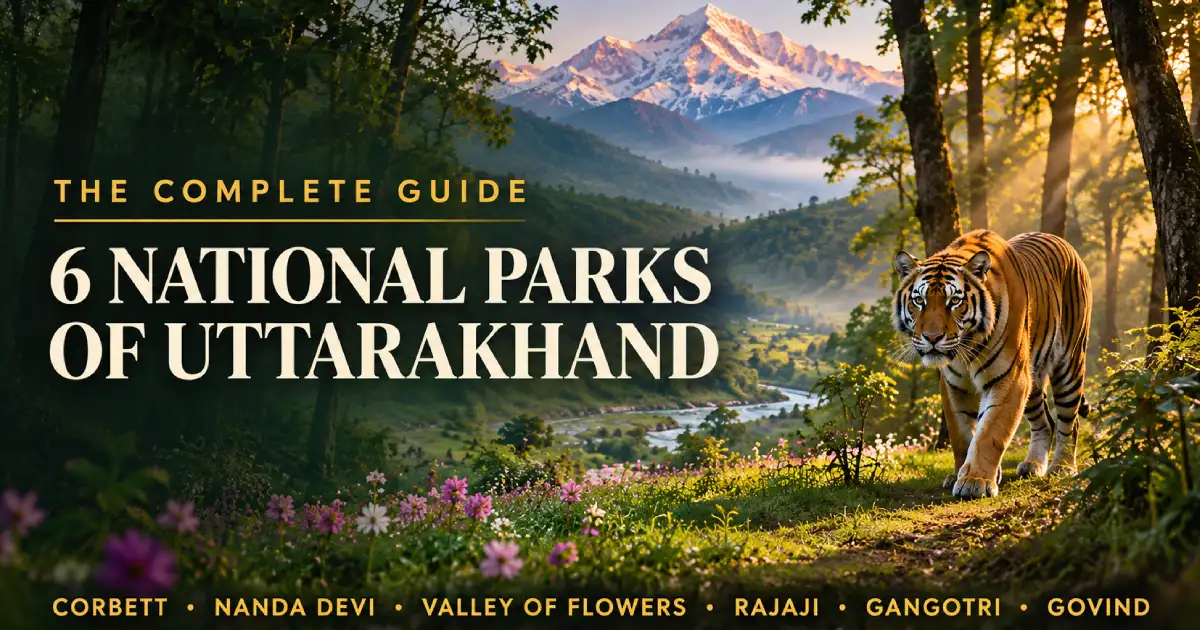
In 1936, a British governor’s name was given to a patch of forest at the foot of the Himalaya, and India’s first national park was born. Today, Uttarakhand has six national parks. Between them, you can watch a tiger step out of a sal forest, see wild elephants move through the Shivalik foothills, or stand in a meadow of wildflowers that a party of lost mountaineers once stumbled into by accident. This is the full story of every national park in Uttarakhand: where each one lies, how big it is, how it began, what lives there, and which one to see first.
How Many National Parks Are There in Uttarakhand?
Uttarakhand has six national parks: Corbett, Nanda Devi, Valley of Flowers, Rajaji, Gangotri, and Govind. This is the official list kept by the Uttarakhand Forest Department, which also says that about 12 percent of the state’s area is protected, in the form of 6 national parks, 7 wildlife sanctuaries, 4 conservation reserves and 1 biosphere reserve.
Together, the six parks cover about 4,915 sq km. They run from the tiger forests of the Terai foothills to glacier country above 7,000 metres, and they fall in six of the state’s 13 districts: Nainital, Chamoli, Haridwar, Dehradun, Pauri Garhwal and Uttarkashi.
Every park has its own story. One began with a British governor, one with a lost mountaineering party, and one with a hunting invitation that turned into a sanctuary. Let us walk through them.
National Parks in Uttarakhand at a Glance
| National Park | District | Established | Area (sq km) |
|---|---|---|---|
| Corbett National Park | Nainital | 1936 | 520.82 |
| Nanda Devi National Park | Chamoli | 1982 | 624.60 |
| Valley of Flowers National Park | Chamoli | 1982 | 87.50 |
| Rajaji National Park | Haridwar, Dehradun, Pauri Garhwal | 1983 | 820.42 |
| Gangotri National Park | Uttarkashi | 1989 | 2,390.02 |
| Govind National Park | Uttarkashi | 1990 | 472.08 |
- Oldest: Corbett National Park (1936), India’s first national park
- Largest: Gangotri National Park (2,390.02 sq km)
- Smallest: Valley of Flowers National Park (87.50 sq km)
- UNESCO World Heritage Site: Nanda Devi and Valley of Flowers, listed together
- Tiger reserves: Corbett and Rajaji
Jim Corbett National Park: Where India’s National Park Story Began
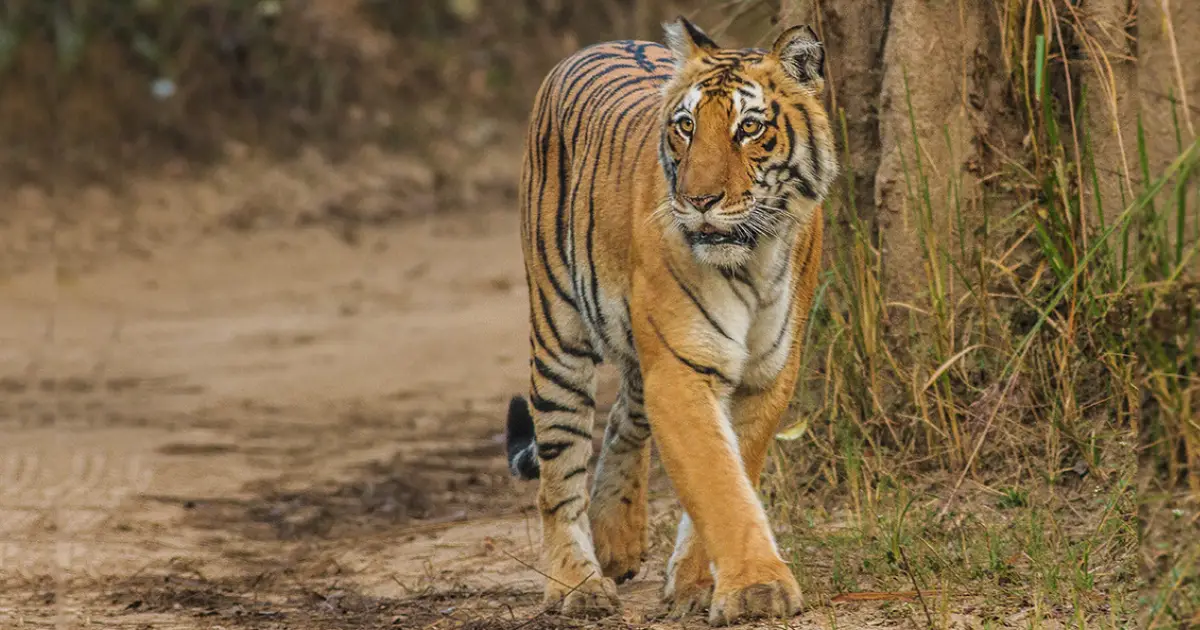
Corbett has the oldest story of the six. It was created in 1936 as Hailey National Park, named after Sir Malcolm Hailey, then Governor of the United Provinces. It was renamed Ramganga National Park in 1954-55, and then Corbett National Park in 1955-56, in honour of the hunter-turned-naturalist and author Jim Corbett, who had helped shape the idea of the park.
When Project Tiger began in 1973, Corbett was one of the first nine tiger reserves in the country. Today the national park covers 520.82 sq km, and the full Corbett Tiger Reserve, with the Sonanadi sanctuary and the buffer zone, spreads over 1,288 sq km, according to the Forest Department.
The park sits in the Nainital district, around the Patli Dun valley carved by the Ramganga River. Sal forest, grassland and river belts make it a rich home for wildlife. According to the 2022 tiger estimate, Corbett held about 260 tigers, the highest number in any tiger reserve in India. More than 580 bird species and about 50 mammal species have been recorded here.
Good to know before you go:
- Safaris are booked online through the official Corbett Tiger Reserve reservation service.
- The Dhikala zone is usually opened around 15 November, so check the portal for current zone dates.
- Corbett Falls (about 20 m high) and the Garjiya Devi temple on the Kosi River are popular stops nearby.
Nanda Devi National Park: The Goddess’s Closed Sanctuary
Nanda Devi is the most guarded of the six. The park lies in the Chamoli district and is built around Nanda Devi, a 7,817 m peak that UNESCO describes as India’s second-highest mountain. The only way into its inner sanctuary is through the Rishi Ganga gorge, one of the deepest in the world.
The mountain’s secret was kept for a long time. Explorers tried for decades to enter, and it was only in 1934 that Eric Shipton and H. W. Tilman broke through the Rishi Ganga gorge into the inner sanctuary. The area became a game sanctuary in 1939, and a national park in 1982. UNESCO inscribed it as a World Heritage Site in 1988.
Then came the closure. Mountaineering and adventure activities inside the park have been banned since 1983, after garbage and damage built up in earlier years. UNESCO notes that, apart from small and well-regulated community-based ecotourism, the area has been free of human pressure since then. This is why scientists value it as a natural “control site” for the Himalayas.
The park covers 624.60 sq km and shelters snow leopards, Himalayan musk deer, and blue sheep (bharal). The villages of Lata and Reni sit near its edge. Reni is where the women of the hills, led by Gaura Devi, stood in front of the axes in 1974 during the Chipko movement. In February 2021, this same Rishi Ganga valley saw the Chamoli disaster, which we cover in our guide to destructive flash floods in Uttarakhand.
Valley of Flowers National Park: The Valley Found by Accident
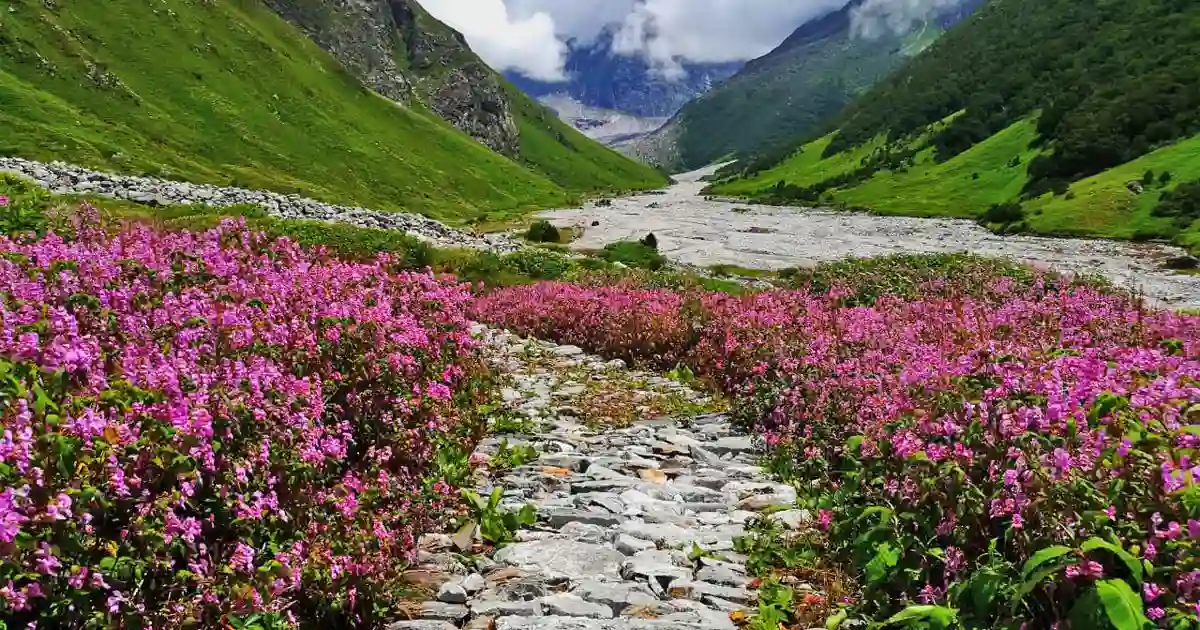
The most colourful of the six parks was discovered by mistake. In 1931, the British mountaineers Frank Smythe, Eric Shipton and R. L. Holdsworth lost their way while returning from a successful climb of Mount Kamet. They walked into a valley full of flowers and named it the “Valley of Flowers”. Smythe later wrote a book of the same name.
In 1939, Joan Margaret Legge, a botanist sent by the Royal Botanic Gardens, Kew, came to study the flowers. She slipped on rocky slopes while collecting plants and died. Her sister later put up a memorial in the valley.
Today, the Valley of Flowers is an 87.50 sq km national park, declared in 1982 and added to the UNESCO World Heritage Site in 2005. It lies between about 3,352 and 3,658 m in the Chamoli district, and one botanical study counted around 520 higher plant species there. The Himalayan black bear, snow leopard, musk deer, blue sheep, and monal pheasant live in and around it.
Planning the trek:
- The journey starts at Govindghat near Joshimath, and the whole trek is about 17 km. Ghangaria is the last settlement, and the same route leads on to Hemkund Sahib.
- The park opens on 1 June each year and closes when the snow returns. Flowers are at their best from mid-July to mid-August.
- A Forest Department permit is needed, valid for three days. Staying overnight inside the park is not allowed, so most visitors stay in Ghangaria.
- Govindghat lies on the road to Badrinath Dham, about 24 km before the shrine, so many pilgrims combine both trips.
Rajaji National Park: The Elephant Forest of the Shivaliks
Rajaji began with a hunting invitation. The story, told by the reserve, is that C. Rajagopalachari, India’s last Governor-General, was invited to a hunt here, but he was so struck by the wildlife that he suggested a sanctuary instead. The area became the Rajaji Sanctuary in 1948 and was named after him (“Rajaji” was his popular nickname).
In 1983, the Rajaji, Motichur and Chilla sanctuaries were merged to form Rajaji National Park. The Ganga flows through the middle of the park and divides it into two parts. The park covers 820.42 sq km across the districts of Haridwar, Dehradun and Pauri Garhwal.
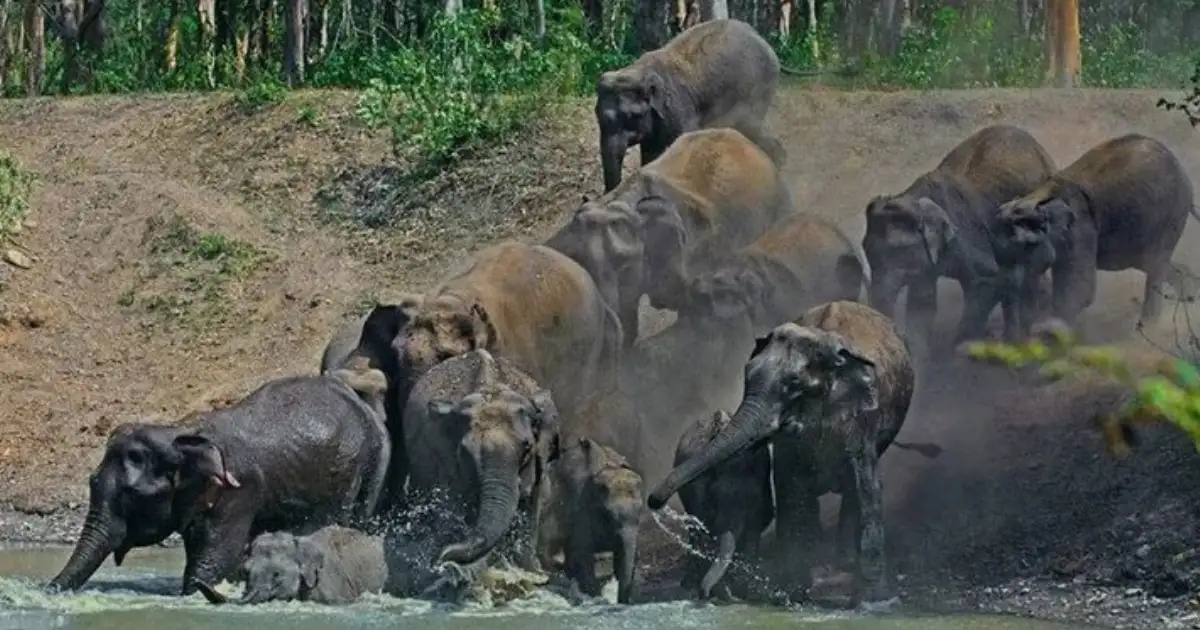
On 15 April 2015, it was notified as the Rajaji Tiger Reserve, India’s 48th tiger reserve and the second in Uttarakhand after Corbett. The reserve grew to 1,075.17 sq km. It is best known for its Asian elephants, and also has tigers, leopards, more than 50 mammal species, and over 300 bird species, including the great pied hornbill. Golden mahseer swim in its rivers.
Gangotri National Park: Where the Ganga Is Born
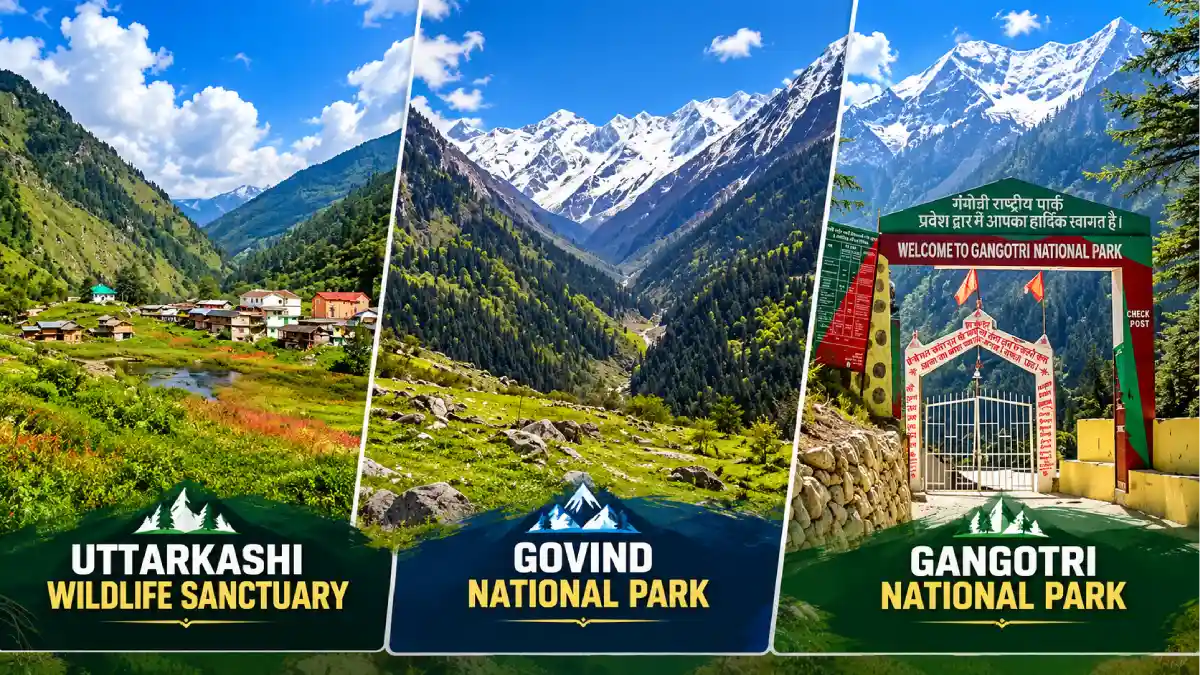
Gangotri is the biggest national park in Uttarakhand, and a very high one. It covers 2,390.02 sq km in the Uttarkashi district, was set up in 1989, and rises from about 1,800 m to over 7,000 m. Its northeastern boundary runs along the international border with China.
Inside the park lies Gaumukh, the snout of the Gangotri glacier and the source of the Bhagirathi, which later becomes the Ganga. The trek begins at Gangotri, near the Gangotri Dham temple, and Gaumukh is about 18 km away. Pilgrims and trekkers walk the same trail.
The park is home to the snow leopard, along with the Asian black bear, brown bear, musk deer, blue sheep, Himalayan tahr, and birds such as the Himalayan monal. Our guide to the monal, the state bird of Uttarakhand, tells more about that bird.
Permit rule: The Gaumukh trail needs a Forest Department permit, issued by the District Forest Officer in Uttarkashi or at the forest office in Gangotri, and only 150 trekkers are allowed per day. The park is shut in winter because of heavy snow, so check dates before you plan.
Govind National Park: The Valley of the Tons
Govind Pashu Vihar is the quietest of the six. It lies in the upper Tons River valley of the Uttarkashi district, and is named after the freedom fighter and statesman Govind Ballabh Pant. It began as the Govind Wildlife Sanctuary in 1955 (485.89 sq km), and the national park (472.08 sq km) was added in 1990. Together, they are often described as one area of about 958 sq km.
The altitude ranges from about 1,400 m to 6,323 m, and there are no safari roads here, so you have to walk. The best-known route is the Har Ki Dun trek of about 38 km from Sankri via Taluka and Osla, ending in a cradle-shaped valley of wild flowers. Another popular spot is the high-altitude lake, Ruinsara Tal.
Govind is a stronghold of the bearded vulture and a home for snow leopard, Asian black bear, brown bear, musk deer, bharal, Himalayan tahr, monal and the western tragopan.
Which National Park in Uttarakhand Should You Visit First?
- To see tigers and take a safari: Corbett National Park
- To see wild elephants near Haridwar and Rishikesh: Rajaji National Park
- For alpine flowers and an easy high-altitude trek: Valley of Flowers
- For a glacier trek to the source of the Ganga: Gangotri National Park
- For a long, quiet valley trek: Govind National Park (Har Ki Dun)
- To learn about the mountain and its history: Nanda Devi, which you can read about but not enter freely
The Nanda Devi and Valley of Flowers sites are described in full on the UNESCO World Heritage page. Rules, permits, and opening dates can change every year, so confirm them with the Forest Department before you travel.
Frequently Asked Questions
How many national parks are there in Uttarakhand?
There are six: Corbett, Nanda Devi, Valley of Flowers, Rajaji, Gangotri, and Govind.
Which is the first national park of Uttarakhand?
Corbett National Park, established in 1936, is the oldest in Uttarakhand and the first national park in India.
Which is the biggest national park in Uttarakhand?
Gangotri National Park is the biggest, with an area of 2,390.02 sq km.
Which national parks in Uttarakhand are UNESCO World Heritage Sites?
Nanda Devi National Park and Valley of Flowers National Park, which are listed together as “Nanda Devi and Valley of Flowers National Parks”. Nanda Devi was inscribed in 1988, and the Valley of Flowers was added in 2005.
Which national parks in Uttarakhand are tiger reserves?
Corbett Tiger Reserve and Rajaji Tiger Reserve. Rajaji was declared a tiger reserve in April 2015.
Can tourists visit Nanda Devi National Park?
The park is strictly protected. Mountaineering and adventure activities inside it have been banned since 1983, and only small, regulated community-based ecotourism takes place on limited portions. Always check with the Forest Department before planning a visit.
Facts, areas, and dates in this guide were checked against official sources: Uttarakhand Forest Department: Wildlife Management, UNESCO World Heritage Centre: Nanda Devi and Valley of Flowers National Parks, eCorbett: Corbett Tiger Reserve online booking
Rules, permits, and opening dates can change, so please confirm them with the Forest Department before you travel.