
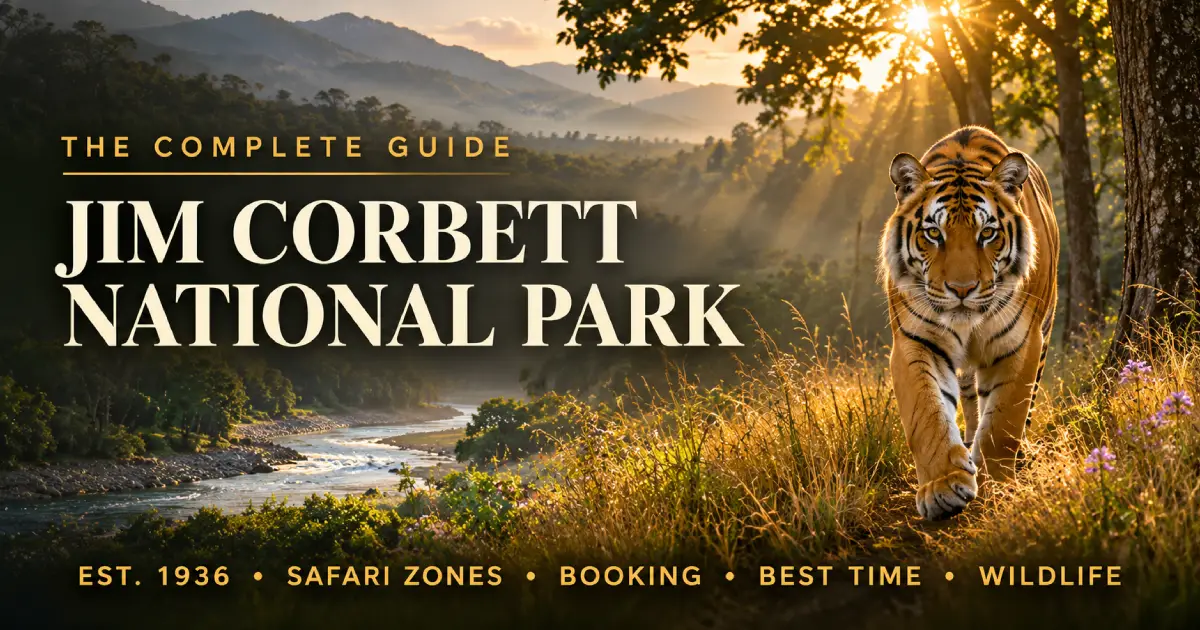
Jim Corbett National Park is the place where India’s wildlife story began. Set in the Himalayan foothills of Uttarakhand along the Ramganga River, it blends sal forests, open grasslands, and river valleys, and it holds more tigers than any other reserve in the country. People come here hoping for a tiger sighting, but many stay for the birds, the elephants, and the quiet of the forest at dawn. If you are planning a visit, this guide covers the park’s history, its wildlife, the safari zones, how to book a permit, and the best time to go.
What Is Jim Corbett National Park?
In 1936, a stretch of forest at the foot of the Himalaya was set aside by law, and India’s first national park was born. It was called Hailey National Park then, after Sir Malcolm Hailey, the Governor of the United Provinces. Today the world knows it as Jim Corbett National Park, the heart of the Corbett Tiger Reserve, and it sits in the Nainital district and the Pauri Garhwal district of Uttarakhand.
This is the full story of Jim Corbett, Uttarakhand’s most famous wild place: how it began, who gave it his name, what lives inside it, how the safari zones work, how to book a safari the right way, and when to go.
- Established: 1936, as Hailey National Park
- Park area: 520.82 sq km (the national park itself)
- Tiger reserve area: 1,288.31 sq km, with about 821 sq km as the core and the rest as buffer
- Districts: Nainital and Pauri Garhwal, with Ramnagar as the gateway town
- Tigers: about 260 inside the reserve in the 2022 estimate, the highest of any tiger reserve in India
- Birds: around 580 species recorded
- Official website: corbettgov.org
Jim Corbett National Park History: From Hailey National Park to Corbett
The story of the first national park in India starts in the 1860s, when British officers took control of this forest and banned cultivation and cattle stations to protect it. In 1879, the forests were declared a reserve forest, where only limited tree felling was allowed.
Early in the 1900s, British conservationists, including E. R. Stevens and E. A. Smythies, began proposing a national park here. The demarcation work started in the 1930s, and the park finally came into being through a special Act in 1936. According to the reserve’s own history, it was the first national park in mainland Asia, and its area was 323.75 sq km. Hunting was prohibited from day one.
- 1936: Hailey National Park is created.
- 1954–55: The park is renamed Ramganga National Park.
- 1956: After the death of Jim Corbett, it is renamed Corbett National Park in his honour. The reserve’s official website gives 1956, while some other sources mention 1957.
- 1966: The park grows to 520.82 sq km.
- 1 April 1973: Project Tiger is launched from Corbett, and it becomes one of the first nine tiger reserves in the country.
- 1991: A buffer zone of 797.72 sq km is added, including the 301.18 sq km Sonanadi Wildlife Sanctuary.
- 26 February 2010: On the recommendation of the National Tiger Conservation Authority, the Uttarakhand government notifies the area in its present form as the Corbett Tiger Reserve.
Who Was Jim Corbett?
Edward James “Jim” Corbett was born on 25 July 1875 in Nainital. His family spent the winters at Kaladhungi, at the foot of the hills, and the young Jim grew up learning the forest, its birds and its animals. He became famous for tracking man-eating tigers and leopards in Kumaon and Garhwal. The first man-eater he killed, the Champawat tiger, was responsible for 436 documented deaths.
His book Man-Eaters of Kumaon, published in 1944, made him known across the world. In later life, he turned into a strong voice for wildlife conservation. Corbett moved to Kenya in 1947 and died in Nyeri on 19 April 1955. His winter home at Kaladhungi is now a museum, and it is one of the best side trips from the park.
Where Is Jim Corbett National Park?
Jim Corbett National Park lies in the foothills of the Himalaya, in the Patli Dun valley, spread over parts of Nainital and Pauri Garhwal. The Ramganga River runs through the park and is its main source of water. The reserve’s headquarters and the main gateway town is Ramnagar in Nainital district. You can see where the park sits among the state’s districts on our Uttarakhand district map.
As per the Nainital district administration, Ramnagar is about 240 km from Delhi by road via Moradabad and Kashipur. Kashipur falls in Udham Singh Nagar district, so most travellers from Delhi pass through it on the way. From Nainital, Ramnagar is about 60 km via Kaladhungi. Ramnagar is also the nearest railway station, and the nearest airport is at Pantnagar, about 80 km from Ramnagar.
Size and Landscape of the Corbett Tiger Reserve
The Corbett Tiger Reserve covers 1,288.31 sq km. It is made up of the Corbett National Park (520.82 sq km), the Sonanadi Wildlife Sanctuary (301.18 sq km), and reserve forest (about 466 sq km). The land rises from roughly 1,300 to 4,000 feet and holds hills, river belts, grasslands, and a large reservoir.
About 40 percent of the forest is sal, with some of the thickest patches between Dhangarhi and Dhikala. Along the rivers, you will find khair and shisham, and in between lie open grasslands that locals call chaur. The famous ones are Dhikala, Phulai, Paterpani, and Bijrani. These meadows came from old settlements and clearings, and they are where deer, elephants, and tigers are often seen.
Wildlife in Jim Corbett National Park
Corbett is best known for tigers. In the 2022 tiger estimate, the reserve held about 260 tigers inside its boundary, the highest number in any tiger reserve in India. In the previous count in 2018, the figure was 231. The reserve’s official website describes Corbett as home to the highest density of tigers in the world.
According to the reserve, the area has 617 plant species, 50 mammal species, 580 bird species, and 25 reptile species. Some of the animals you can hope to see are:
- Big cats and bears: tiger, leopard, leopard cat, jungle cat and sloth bear
- Elephants and deer: wild Asian elephants, chital, sambar, hog deer and barking deer
- Other mammals: nilgai, goral, wild boar, otter and mongoose
- Reptiles: gharial, mugger crocodile, python, king cobra and monitor lizard
- Fish: mahseer and goonch in the Ramganga and other rivers
Birders will love it too. With over 580 species recorded, from kingfishers to the Asian paradise flycatcher, the park is a favourite for bird watching.
Jim Corbett Safari Zones and Timings
The reserve has several tourism zones, and each has its own entry gate and opening period. As listed on the official website:
- Jhirna (Dhela gate): open throughout the year
- Dhela (Dhela gate): open throughout the year
- Garjia (Garjiya gate): open throughout the year
- Bijrani (Amdanda gate): 15 October to 30 June
- Dhikala (Dhangari gate): 15 November to 15 June
- Durgadevi (Durgadevi gate): 15 November to 15 June
- Sonanadi (Vatanvasa gate) and Pakhro (Pakhro gate): 15 November to 15 June, with Kothdwar as the nearest town
One thing to remember is that Dhikala works differently from the rest. Jeep safari is not available there. The day safari in Dhikala is by canter, a shared vehicle with a capacity of 16 people, and you can board it either from the Corbett office in Ramnagar or from the Dhangari gate.
Jim Corbett Safari Booking: How to Book Your Permit
Booking a Jim Corbett safari is done online, and the reserve says its own website is the only official place to do it. The steps are simple, but the rules are strict. Here is what the official booking guide says:
- Book in advance: Jeep and canter permits open up to 45 days before the visit date, and the window opens each day progressively.
- Choose zone and shift: Select the zone, date, and either a morning or an afternoon safari. One booking can have a maximum of 6 people.
- Children: Children below 12 years do not need a permit for a jeep safari.
- ID proof is a must: From 22 September 2026, the group leader has to upload a clear photo of both sides of a valid ID, and for the other members, only the ID number is entered. Original IDs are checked at the gate, and a mismatch can mean being refused entry.
- Jeep charges: The permit fee is for one gypsy, whether 1 or 6 people sit in it. Guide and driver charges are paid separately.
- Payment: A WhatsApp-enabled mobile number is needed for OTP, and you receive a ticket with a QR code after payment.
- No refunds: Tickets are non-refundable and non-transferable once paid.
The portal also has a mandatory 180-second wait on the visitor details page, so do not panic if it does not let you move ahead quickly. For the visit date itself, the last time for online booking is 6:30 AM for the morning shift and 4:00 PM for the afternoon shift.
Be careful with fake websites. The reserve has published a long list of unauthorised sites that copy its name, and it advises visitors to book only on the official Corbett Tiger Reserve booking guide and portal.
Where to Stay Near Jim Corbett National Park
If you are searching for Jim Corbett hotels, you have two broad choices. The first is a night stay inside the reserve in a forest rest house such as the ones at Dhikala and Jhirna. These are booked through the official portal, and a night-stay booking includes two jeep safaris. For the 2026–27 season, the official schedule shows the first check-in for Indian visitors on 15 November 2026, with later booking windows opening roughly every month.
The second choice is a private resort or hotel in and around Ramnagar and Kaladhungi. These are not run by the reserve, so check the safari arrangement carefully before you pay, and remember that the safari permit itself still has to be booked on the official portal.
Best Time to Visit Jim Corbett National Park
The main tourism zones are open from mid-November to mid-June, which is why that stretch is the main visiting season. Dhikala and Durgadevi open on 15 November, Bijrani opens a month earlier, on 15 October, and Jhirna, Dhela and Garjia stay open all year. The core zones are closed in the monsoon months, so a trip between July and October will mostly be limited to those year-round zones.
Winter mornings in the foothills are cold, especially in an open jeep, so carry warm layers. The reserve also asks visitors to wear dull colours such as khaki or olive that blend into the forest. Rules, permits, and opening dates can change from year to year, so always check the official website before you book.
Rules Every Visitor Should Know
- No mobile phones inside the tourism zones of the core habitat, as per a Supreme Court order mentioned on the official website.
- No walking or trekking inside the tiger reserve, and no driving after sunset.
- A registered nature guide is compulsory on every excursion.
- No pets, no firearms, and no lighting of fires or smoking outside rest-house areas.
- Do not litter, and do not feed, tease, or chase animals. Blowing horns and driving off the marked routes are prohibited.
Places to See Near Jim Corbett National Park
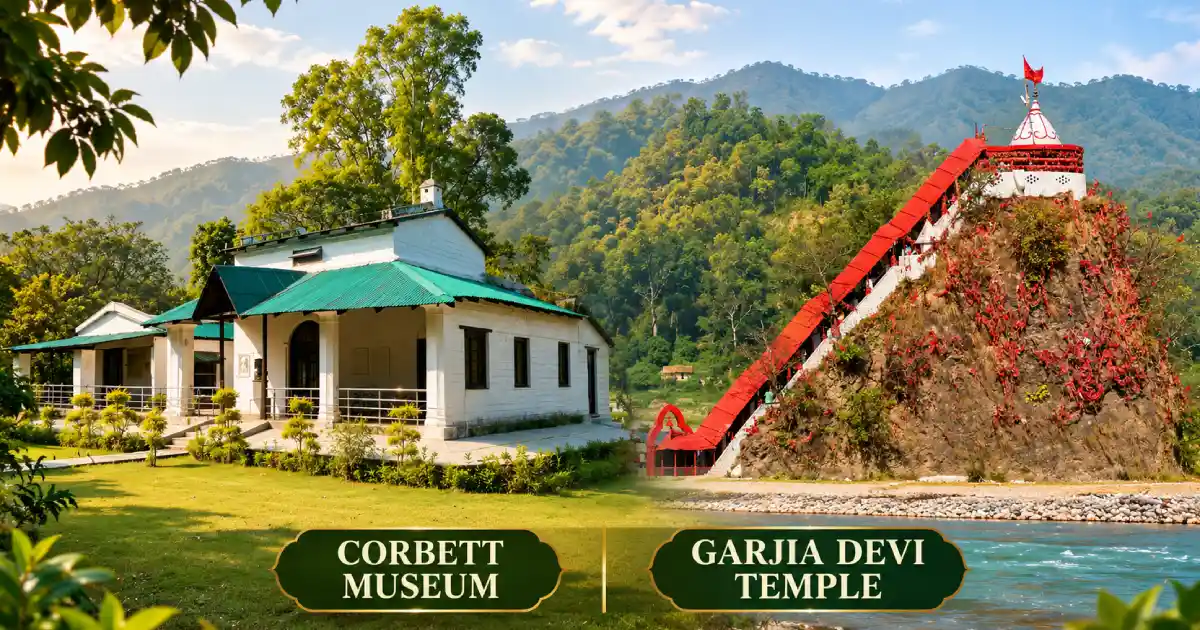
- Jim Corbett Museum, Kaladhungi: the winter home of Jim Corbett, now open as a museum, with the Kaladhungi heritage trail nearby.
- Garjiya Devi Temple: a temple of Goddess Durga on a huge rock in the Kosi River, about 14 km from Ramnagar on the way to the park.
- Corbett Falls and Sitabani: two popular stops for a day out of the jungle.
- Kalagarh Dam and Barati Rau Falls: more scenic spots listed by the district administration.
- Butterfly Park and Interpretation Centre: both are listed as attractions on the reserve’s official website.
Corbett: Among the National Parks of Uttarakhand
Uttarakhand has six national parks: Corbett, Nanda Devi, Valley of Flowers, Rajaji, Gangotri and Govind. Corbett is the oldest of the six and the first national park in India, and together with Rajaji it is one of the two tiger reserves of the state. In the 2022 estimate, Uttarakhand as a whole was home to 560 tigers, and Corbett alone accounted for 260 of them.
Frequently Asked Questions
Which is the first national park in India?
Jim Corbett National Park, established in 1936 as Hailey National Park, is the first national park in India.
Where is Jim Corbett National Park located?
It is in the foothills of the Himalayas in Uttarakhand, across the Nainital and Pauri Garhwal districts. Ramnagar in Nainital district is the main gateway.
Why is it called Jim Corbett National Park?
It is named after Jim Corbett, the hunter-turned-naturalist and author who helped shape the idea of the park. It was first called Hailey National Park and then Ramganga National Park before taking his name.
How many tigers are there in Jim Corbett National Park?
The 2022 estimate counted about 260 tigers inside the Corbett Tiger Reserve, the highest number for any tiger reserve in India. The count in 2018 was 231.
How can I book a Jim Corbett safari?
Book online on the official Corbett Tiger Reserve website. Jeep and canter permits open up to 45 days in advance; a booking can have up to 6 people, and a valid ID is mandatory.
Is Jim Corbett National Park open all year?
Not fully. Jhirna, Dhela, and Garjia are open throughout the year; Bijrani is open from 15 October to 30 June, and Dhikala and Durgadevi are open from 15 November to 15 June.
Is jeep safari available in Dhikala?
No. The official booking guide says jeep safari is not available in the Dhikala zone, and the day safari there is by canter.
Jim Corbett National Park is more than a place to spot a tiger. It is where India’s conservation story took its first steps, and it still shapes how the country protects its wild places. Plan early; book only on the official portal.
Facts, areas, and dates in this guide were checked against official sources, including the Corbett Tiger Reserve website and the Nainital district administration. Rules, permits, and opening dates can change, so please confirm them on the official website before you travel.